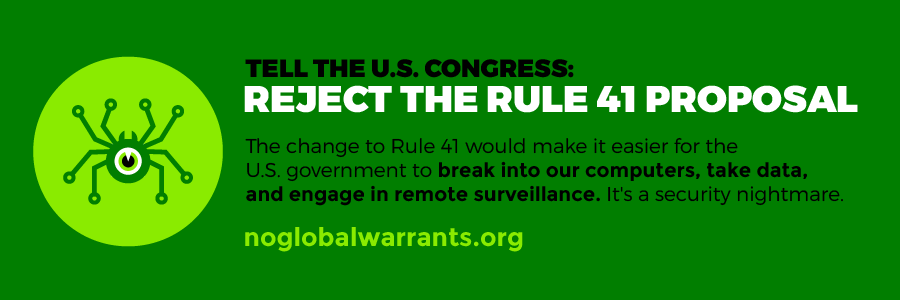
EFF, the Tor Project, and dozens of other organizations concerned about the future of our digital security are taking a stand for users everywhere. We’re organizing a campaign and day of action to speak out against the changes to Rule 41.
Here's the deal: The Department of Justice is using an obscure procedure to push through a rule change that will greatly increase law enforcement’s ability to hack into computers located around the world. It’s an update to Rule 41 of the Federal Rules of Criminal Procedure. If Congress does nothing, this massive change will automatically go into effect on December 1. We’ve written a detailed explanation of the changes to Rule 41, which explains why this update will result in a dramatic increase in government hacking.
We’ve put together an embeddable banner to allow people to email members of the U.S. Congress or sign a petition opposing the changes to Rule 41. Please, check out the instructions for embedding the banner directly or hosting your own copy. The code will automatically display the banner on our day of action—Tuesday, June 21—and then disappear automatically.
Even if you don’t run a website where you can embed the banner, you can still help. On or before June 21, you can send an email to your member of Congress. Please post about Rule 41 on social media or a blog, and ask your friends to speak out. Feel free to get creative by hosting events in your home community, taking a photo, and sending it our way. And if you do plan something, please let us know!
Thanks for your help,
Rainey Reitman Activism Director Electronic Frontier Foundation Support our work.
Apple to Oppose Judge's Order to Unlock iPhone - Apple CEO Tim Cook said the company will oppose a federal judge's order to help the Justice Department unlock a phone used by a suspect in the San Bernardino attack, which killed 14 people. Video published on Feb 17, 2016
UPDATE: Apple Gains Silicon Valley's Backing in Government Fight - Bloomberg Business: “This is a classic legislative function, the courts aren’t really equipped to weigh the policies in the forum of a democratic society -- what’s more important, protection against terrorists or protections against your privacy?”--Robert Cattanach, a lawyer at Dorsey & Whitney who practices in areas of regulatory litigation including cybersecurity.
Apple CEO Tim Cook has written a customer letter in response to, and opposing, a US District Court Order (embedded below) requiring Apple help the FBI break into the iPhone 5C used by San Bernardino shooter Syed Rizwan Farook. Federal Magistrate Judge Sheri Pym said that Apple must provide "reasonable technical assistance" to the FBI, which would require Apple:
"Specifically, the FBI wants us to make a new version of the iPhone operating system, circumventing several important security features, and install it on an iPhone recovered during the investigation. In the wrong hands, this software — which does not exist today — would have the potential to unlock any iPhone in someone’s physical possession." -- Apple Customer Letter, infra
Customer Letter - Apple: (February 16, 2016)--excerpt (read the full letter at the foregoing link)-- ".... A Dangerous Precedent - Rather than asking for legislative action through Congress, the FBI is proposing an unprecedented use of the All Writs Act of 1789 to justify an expansion of its authority. The government would have us remove security features and add new capabilities to the operating system, allowing a passcode to be input electronically. This would make it easier to unlock an iPhone by “brute force,” trying thousands or millions of combinations with the speed of a modern computer.
"The implications of the government’s demands are chilling. If the government can use the All Writs Act to make it easier to unlock your iPhone, it would have the power to reach into anyone’s device to capture their data. The government could extend this breach of privacy and demand that Apple build surveillance software to intercept your messages, access your health records or financial data, track your location, or even access your phone’s microphone or camera without your knowledge.
"Opposing this order is not something we take lightly. We feel we must speak up in the face of what we see as an overreach by the U.S. government. We are challenging the FBI’s demands with the deepest respect for American democracy and a love of our country. We believe it would be in the best interest of everyone to step back and consider the implications.
"While we believe the FBI’s intentions are good, it would be wrong for the government to force us to build a backdoor into our products. And ultimately, we fear that this demand would undermine the very freedoms and liberty our government is meant to protect."--Tim Cook, Apple CEO (emphasis added)
Embedded below is the US District Court Order Apple is challenging:
"We learned on Tuesday evening that a U.S. federal magistrate judge ordered Apple to backdoor an iPhone that was used by one of the perpetrators of the San Bernardino shootings in December. Apple is fighting the order which would compromise the security of all its users around the world.
"We are supporting Apple here because the government is doing more than simply asking for Apple’s assistance. For the first time, the government is requesting Apple write brand new code that eliminates key features of iPhone security—security features that protect us all. Essentially, the government is asking Apple to create a master key so that it can open a single phone. And once that master key is created, we're certain that our government will ask for it again and again, for other phones, and turn this power against any software or device that has the audacity to offer strong security.
"The U.S. government wants us to trust that it won't misuse this power. But we can all imagine the myriad ways this new authority could be abused. Even if you trust the U.S. government, once this master key is created, governments around the world will surely demand that Apple undermine the security of their citizens as well.
"EFF applauds Apple for standing up for real security and the rights of its customers. We have been fighting to protect encryption, and stop backdoors, for over 20 years. That's why EFF plans to file an amicus brief in support of Apple's position." (emphasis added)
UPDATE: Why India Blocked Facebook's 'Free Basics' Internet Program? Electronic Frontier Foundation’s Jeremy Malcolm and Techonomy chief executive officer David Kirkpatrick discussed net neutrality and India's banning Facebook’s free basics with Emily Chang on “Bloomberg West” --UPDATE note: video subsequently removed by Bloomberg but essentially EFF's Jeremy Malcolm said the program violates "zero-rating" aspect of net neutrality.
Zero-rating - Wikipedia: "Internet services like Facebook, Wikipedia and Google have built special programs to use zero-rating as means to provide their service more broadly into developing markets.[citation needed] The benefit for these new customers, who will mostly have to rely on mobile networks to connect to the Internet, would be a subsidised access to services from these service providers. The results of these efforts have been mixed, with adoption in a number of markets, sometimes overestimated expectations and perceived lack of benefits for mobile network operators. In Chile, the national telecom regulator ruled that this practice violated net neutrality laws and had to end by June 1, 2014" India’s Blow Against Facebook Sets Up a Grand Experiment in Net Neutrality: "The ruling from India’s regulator ... [m]aking data for certain services free is anticompetitive and gives companies undue control over the information and services poor people can access, it says: “Allowing price differentiation based on the type of content being accessed on the internet, would militate against the very basis on which the internet has developed and transformed the way we connect with one another.”"
Free Basics by Facebook – Internet.org: "Free Basics by Facebook provides people with access to useful services on their mobile phones in markets where internet access may be less affordable. The websites are available for free without data charges, and include content on things like news, employment, health, education and local information. By introducing people to the benefits of the internet through these websites, we hope to bring more people online and help improve their lives."
More info: Where Free Basics Is Available – Internet.org
TPP Crunch Time: What's Holding It Up? (source: Bloomberg) ITS Global Managing Director Alan Oxley discusses the Trans-Pacific Partnership, and the talks that resume in Atlanta this week, and whether a deal can be reached. He speaks to Bloomberg's Angie Lau on "First Up." Published on Sep 28, 2015
ITS Global | Consultants on Global Issues: [domain name: itsglobal.net]"ITS Global is a dynamic consultancy specialising in public policy in the Asia Pacific region. Its expertise include: trade, economics and investment; environment and sustainability; aid and development; and corporate social responsibility and risk. It enables clients to assess implications of policy; develop and implement strategies to manage policy impacts; and to improve policy formulation."
What is the Trans-Pacific Partnership (TPP)? According to the Electronic Frontier Foundation (EFF): "The Trans-Pacific Partnership (TPP) is a secretive, multinational trade agreement that threatens to extend restrictive intellectual property (IP) laws across the globe and rewrite international rules on its enforcement. The main problems are two-fold: (1) Intellectual Property Chapter: Leaked draft texts of the agreement show that the IP chapter would have extensive negative ramifications for users’ freedom of speech, right to privacy and due process, and hinder peoples' abilities to innovate. (2) Lack of Transparency: The entire process has shut out multi-stakeholder participation and is shrouded in secrecy. The twelve nations currently negotiating the TPP are the US, Japan, Australia, Peru, Malaysia, Vietnam, New Zealand, Chile, Singapore, Canada, Mexico, and Brunei Darussalam. The TPP contains a chapter on intellectual property covering copyright, trademarks, and patents. Since the draft text of the agreement has never been officially released to the public, we know from leaked documents, such as the May 2014 draft of the TPP Intellectual Property Chapter [PDF], that US negotiators are pushing for the adoption of copyright measures far more restrictive than currently required by international treaties, including the controversial Anti-Counterfeiting Trade Agreement (ACTA). The TPP Will Rewrite Global Rules on Intellectual Property Enforcement All signatory countries will be required to conform their domestic laws and policies to the provisions of the Agreement. In the US, this is likely to further entrench controversial aspects of US copyright law (such as the Digital Millennium Copyright Act[DMCA]) and restrict the ability of Congress to engage in domestic law reform to meet the evolving IP needs of American citizens and the innovative technology sector. The recently leaked US-proposed IP chapter also includes provisions that appear to go beyond current US law. The leaked US IP chapter includes many detailed requirements that are more restrictive than current international standards, and would require significant changes to other countries’ copyright laws. These include obligations for countries to: Place Greater Liability on Internet Intermediaries: The TPP would force the adoption of the US DMCA Internet intermediaries copyright safe harbor regime in its entirety. For example, this would require Chile to rewrite its forward-looking 2010 copyright law that currently establishes a judicial notice-and-takedown regime, which provides greater protection to Internet users’ expression and privacy than the DMCA. Escalate Protections for Digital Locks: It will compel signatory nations to enact laws banning circumvention of digital locks (technological protection measures or TPMs)[PDF] that mirror the DMCA and treat violation of the TPM provisions as a separate offense even when no copyright infringement is involved. This would require countries like New Zealand to completely rewrite its innovative 2008 copyright law, as well as override Australia’s carefully-crafted 2007 TPM regime exclusions for region-coding on movies on DVDs, video games, and players, and for embedded software in devices that restrict access to goods and services for the device—a thoughtful effort by Australian policy makers to avoid the pitfalls experienced with the US digital locks provisions. In the US, business competitors have used the DMCA to try to block printer cartridge refill services, competing garage door openers, and to lock mobile phones to particular network providers. Create New Threats for Journalists and Whistleblowers: Dangerously vague text on the misuse of trade secrets, which could be used to enact harsh criminal punishments against anyone who reveals or even accesses information through a "computer system" that is allegedly confidential. Expand Copyright Terms: Create copyright terms well beyond the internationally agreed period in the 1994 Agreement on Trade-Related Aspects of Intellectual Property Rights (TRIPS). The TPP could extend copyright term protections from life of the author + 50 years, to Life + 70 years for works created by individuals, and either 95 years after publication or 120 years after creation for corporate owned works (such as Mickey Mouse). Read more about the TPP Copyright Trap. Enact a "Three-Step Test" Language That Puts Restrictions on Fair Use: The U.S. Trade Representative (USTR) is putting fair use at risk with restrictive language in the TPP's IP chapter. US and Australia have proposed very restrictive text, while other countries such as Chile, New Zealand, and Malaysia, have proposed more flexible, user-friendly terms. Adopt Criminal Sanctions: Adopt criminal sanctions for copyright infringement that is done without a commercial motivation. Users could be jailed or hit with debilitating fines over file sharing, and may have their property or domains seized even without a formal complaint from the copyright holder...."
"Individual supporters have been the foundation of EFF's work for 25 years, defending privacy and free expression while advancing creativity and online rights. As we approach our 25th anniversary and face new threats to freedom, it's important to strengthen that foundation further.
"We hope to add 2,500 new and renewing members before our 25th anniversary on July 16. Please give to build a stronger digital rights community and celebrate 25 years of important work!"
Comments received by ICANN overwhelmingly OPPOSE extending URS Policy to .TRAVEL and other legacy gTLDs (generic top-level domains). Comment period closed June 21, 2015 23:59 UTC.
Only two comments FOR extending the URS Policy to .TRAVEL were received--one from new gTLD Registry Operator DONUTS and the other from IPC (Intellectual Property Constituency).
Among the many comments OPPOSING were those received from the Electronic Frontier Foundation (EFF), the ICANN Business Constituency, the ICANN Non-Commercial Stakeholders Group (NCSG), the Internet Commerce Association (ICA), and IP Justice, which stated:
"IP Justice opposes this illegitimate attempt by ICANN staff to further circumvent proper policy development processes in the creation and imposition of new gTLD policy. In addition to the inappropriate process utilized, the policy itself will chill freedom of expression as domain names will be quickly suspended without any fair opportunity for consumers to defend their lawful rights to use their domain names. Particularly at this critical time when the world is watching ICANN to see if it has begun to fix its accountability crisis, this illegitimate imposition of a dangerous policy on the world is extremely disturbing."
Domain Mondo thanks all those who submitted comments opposing the proposed extension of URS policy to .TRAVEL. Thanks also to Philip Corwin and the Internet Commerce Association for taking the lead and "sounding the alarm" on this attempt by ICANN staff to apply new gTLD URS policy against legacy gTLD domain name registrants. Below are the links to all comments that were received--FOR and OPPOSE--
Join us in San Francisco on Thursday, July 16 to celebrate EFF's 25th anniversary of fighting for digital rights!
EFF 25th Anniversary Party + Minicon Thursday, July 16, 2015
DNA Lounge 375 Eleventh Street San Francisco
Minicon from noon to 4 pm Party from 8 pm to late
Since 1990, EFF attorneys, activists, and technologists, along with volunteers, members, and donors, have worked to protect essential constitutional rights as digital technologies have transformed our lives. In our 25th year, join us in celebrating this powerful community fighting for the users—even and especially as we steel ourselves for the challenges to come.
We're hosting two events at DNA Lounge on Thursday, July 16 to mark this milestone. Starting at noon, we're hosting a minicon—an afternoon series of discussions and panels about the past, present, and future of online rights.
Later that evening at 8 pm, we'll kick off EFF's 25th Anniversary Party, featuring musical performances, dancing, and toasts hosted by our special guest emcees: Cory Doctorow and Wil Wheaton!
---------------
If any reader is interested in attending this event, ticket info is below:
When and Where
Thursday, July 16, 2015
@ DNA Lounge
375 Eleventh St., San Francisco, CA 94103
Minicon: 12pm-4pm
Party: 8pm-2am
"The creepy spying power buried in the Patriot Act" - The Electronic Frontier Foundation (EFF) — an advocacy organization that has worked on these issues for a long time — has put together a video that explains the Patriot Act, Section 215 issue and what's at stake--
A frequently misused section of the Patriot Act is coming up for Congressional renewal, and we have a chance to stop it. Visit https://fight215.org to finally destroy this instrument of mass government surveillance.
Ending phone record surveillance is the first step to reining in surveillance abuses by the NSA. Please join us in making this the year we stand for privacy and liberty, not secrecy and fear. Fight215.org
Domain Mondo recently received the following notices from Namecheap:
"This is an official notification regarding a cost increase for .NET domain names. VeriSign, the registry responsible for .net, is raising its costs for .net domain registrations, renewals, and transfers. As a result, we are forced to update our prices as well. On January 30th, 2015, the new price for .net domains will be $12.48/yr. + the ICANN fee. We will continue to offer multi-year registration and renewal discounts on our site. In reaction to this increase, we are having a Renewal Special on the 29th of January ($0.98 off your regular renewal rate). You will not need a coupon to take advantage of this deal. Just process your renewal and the price will automatically update in your cart. Mark the date, as it's coming up quickly. If you cannot join us on Friday, 29th January, we highly recommend that you renew any .net domains (for multiple years) prior to January 30, 2015, in order to take advantage of your current price and to save money in the long run."
In addition, Namecheap is having a special MoveYourDomainDay on January 27th: "... we hosted the first official MoveYourDomainDay in 2012 as a call-to-action for those who opposed SOPA and wanted to leave service providers who supported SOPA and other such ill-conceived legislation. Every year, our lawmakers propose new laws restricting internet freedom. That's why we continue to fight on with our annual MYDD. To our loyal clients: Thank you for being part of this important work. Every year, as part of our MYDD effort, Namecheap donates a portion of the day’s sales to online freedom fighters the Electronic Frontier Foundation. EFF is a donor-supported membership organization that works to protect fundamental rights regardless of technology and to educate the public about digital rights ..."
"MoveYourDomainDay will happen again on January 27, 2015. On that day, you can transfer your .com/.net/.org/.biz/.info for only $3.98 (plus applicable ICANN fees) with coupon code NC15MYDD, and you get an additional year on your domain name when you transfer. Shared hosting plans (Value, Professional, Ultimate) will all be 50% off with coupon code MYDDHOST15."
Namecheap: "The transfer coupon is limited to 50 domains and one usage per household/business. You keep any remaining time you have on the domain when you transfer, and the transfer process adds one more year. So if you have 1.5 years on the domain before you transfer, you’ll have 2.5 years afterward."
"For every domain transferred or hosting plan purchased, up to 10,000, Namecheap will donate $0.50 to the Electronic Frontier Foundation. The donation amount goes up to $1.00 per domain/hosting plan if we exceed 10,000. And if we exceed 20,000 domains transferred/hosting plans purchased, Namecheap will donate $1.50 for each transaction. The Electronic Frontier Foundation is the leading non-profit organization defending civil liberties in the digital world. Founded in 1990, they fight for online privacy rights, internet freedom, and anti-censorship. Visit them at www.eff.org."
One ICANN director, more than 10 years ago, stood alone (with assistance from the Electronic Frontier Foundation a/k/a EFF) to try to make ICANN a little more open, transparent, and accountable, instead of its often closed, secret, top-down method of internet governance --
Auerbach v. ICANN Lawsuit - ICANN: Marina del Rey, California, USA (29 July 2002) -- "At a hearing today, Los Angeles Superior Court Judge Dzintra Janavs ordered that ICANN Director Karl Auerbach should be allowed to inspect specified ICANN documents, but also ruled that Auerbach must respect ICANN's confidentiality designations, with the Court to resolve any disagreements over the propriety of those designations. . . . In her analysis, Judge Janavs ruled that California law does not permit California non-profit corporations to place any restrictions or conditions on director's inspection rights, but allows only courts to place restrictions, after a demand for inspection has been refused. In this respect, the court rejected ICANN's position. ICANN respectfully disagrees and will consider whether to appeal this decision upon review of the Court's written judgment, which will be issued next week. The Court also ruled orally that ICANN must, by Friday of this week, provide Mr. Auerbach with electronic copies of all "non-confidential" (as designated by ICANN) materials he has requested that already exist in electronic form...."
ICANN, reluctantly, complied with the Court's ruling but thereafter changed the rules on representation and selection of directors to ICANN's Board of Directors [so ICANN would not have any more "Karl Auerbachs" who might demand an open, transparent, and accountable ICANN?]