Showing posts with label users. Show all posts

2019-06-12

Mary Meeker’s 2019 Internet Trends Report & Highlights

Mary Meeker’s 2019 Internet Trends Report (pdf) embed below:
Internet Trends archive: https://www.bondcap.com/#archive
Highlights:

Global Internet Users 3.8B (51% of world population), Growth Slowing: +6% vs. +7% Y/Y

Top 30 Global Internet Market Capitalization Leaders: USA 18 of 30, China 7 of 30

Top 30 Global Market Capitalization Leaders: USA 23 of 30, technology 9 of 30

USA E-Commerce Growth +12.4% vs. +12.1% (Y/Y – Q1 vs. Q4)

USA E-Commerce as % of All Retail Sales: 15% vs. 14% Y/Y

Media Time vs. Advertising Spending: Mobile @ Equilibrium (2018), Desktop (2015)

Internet Ad Revenue Growth Decelerating: +20% vs. +29% at Leading USA Platforms (Y/Y  Q1 vs. Q4). Internet Ad Buying: Programmatic Gains vs. Direct, Negatively Impacting Pricing.

Effective + Efficient Marketing = One’s Own Product + Happy Customers + Recommendations

USA Digital Media Usage Growth Accelerating: +7% vs. +5% Y/Y;  More time spent on Mobile devices than TV.

Usage: Images Increasingly Relevant Way to Communicate, e.g., Twitter: >50% of Tweet Impressions include Images / Video / Other Media.

Interactive Gaming Players Accelerating: 2.4B +6% vs. +5% Y/Y. Interactive Gaming =
Real-Time Play + Talk / Text + Watch… Social in Nearly All Ways.

Freemium Business Evolution Started in Gaming, Evolving / Emerging in Enterprise + Consumer…All In… Just Getting Started.

Cloud Deployment Revenue +58% Y/Y

Digital Payments >50% of Day-to-Day Transactions

Data Collection + Analysis + Utilization Evolving From Humans to Humans / Computers: Data is now fundamental to how people work & the most successful companies have intelligently integrated it into everyone's daily workflow… Data is the new application--Frank Bien, CEO & President, Looker, June, 2019. Consumers + Businesses + Regulators Increasingly Drinking from Data Firehose.

"Problematic" Internet Content: Media Maxim "People Prefer Negative News."

World Wide Web  v.  Webs of Worlds Driven by Local Regulation.

Cyber Attacks Sophistication + Scope Continue to Rise, Particularly State Sponsored 

Global Relative GDP (Current $): China + USA + India Rising, ... Europe Falling

Cross-Border Trade is 29% of Global GDP.

USA Consumer Confidence Index High & Rising @ 97 vs. 88 Sixty-Five Year Average 
Economy / Employment (USA): Unemployment @ 19 Year Low… Job Openings @ All-Time High and Wages Rising.

ONLINE EDUCATION = BIG NUMBERS + BIG GROWTH

Areas prime for innovation in USA: 1. Healthcare; 2. Government.

See also tweets at @bondcap.
feedback & comments via twitter @DomainMondo


DISCLAIMER

2019-04-02

The Story of Yelp $YELP - Innovation, Competition, Next Move? (video)

The Rise And Fall Of Yelp?

The story of Yelp and why the company lost its 5-star rating. When Yelp went public in 2012, the popularity of the review site was quickly growing and its stock soared. But it’s been a rocky road since then as advertisers fled the platform and as competition has increased from Google, Facebook and others. CNBC.com video above published Mar 28, 2019.
  • Yelp Inc.
  • Headquarters: San Francisco, CA
  • Domain: yelp.com
  • Founded: July 2004, San Francisco, CA
  • CEO: Jeremy Stoppelman
  • Revenue: 943 million USD (2018)
  • Number of employees: 4,350
  • CFO: Lanny Baker
  • Founders: Russel Simmons, Jeremy Stoppelman
  • NYSE: YELP (IPO 2012) MarketCap: ~$2.83B (March 29, 2019)
$YELP


feedback & comments via twitter @DomainMondo


DISCLAIMER

2018-12-11

Google CEO Testifies Before House Judiciary Committee Dec 11 Video

Transparency & Accountability:
Examining Google and its Data Collection, Use and Filtering Practices

House Judiciary Committee Hearing Dec 11, 2018--hearing begins @29:14 in the video replay above--main witness: Mr. Sundar Pichai, CEO Google; witness's prepared statement (pdf) embed below.

Wednesday, December 5, 2018 at 10:00 a.m. EST: U.S. House Judiciary Committee hearing entitled, “Transparency & Accountability: Examining Google and its Data Collection, Use and Filtering Practices” to examine potential bias and the need for greater transparency regarding the filtering practices of tech giant Google.

Links: 


source: statista.com

feedback & comments via twitter @DomainMondo


DISCLAIMER

2018-10-22

Digital Winners & Losers: Instagram, Amazon, Nike, Sears (video)

The Amazon of 1886

L2inc.com video above published Oct 18, 2018: Professor Galloway's on his week's Digital Winners & Losers: Facebook's Instagram, and the company that taught us how to shop just got killed by the company that taught us how to shop online, and more. 

Some say Instagram shamelessly copied Snapchat’s popular Stories feature, nevertheless, Instagram’s simple design appears to be more appealing to users than Snapchat’s sometimes confusing user interface. Facebook acquired Instagram for $1 billion in 2012, and Instagram recently passed the 1 billion monthly active users mark:
source: statista.com
Sources:
(00:12) Source: Gartner L2 Analysis of CNN, TechCrunch, and Snap Data. 
(00:48) Source: “Amazon Raises Minimum Wage to $15 For All US Employees,” CNBC, October 2018. 
(01:24) Source: World Inequality Database. 
(01:24) Source: Mother Jones, 2016. 
(02:00) Source: “Sears Reshaped America, From Kenmore to Allstate,” Wall Street Journal, October 2018.
(02:05) Source: “The Rise and Fall of Sears,” Smithsonian Magazine, July 2017. https://bit.ly/2q0NOCo 
(02:34) Source: Macrotrends. 
(02:42) Source: “Amazon Takes a Page From Toys ‘R’ Us With a Holiday Catalog,” Bloomberg, July 2018.
(03:29) Source: “Justin Gallegos” video.r 2018.

Song: Everybody Wants To Rule The World by Tears For Fears

Transcript (unedited auto-generated):
00:00  a win our Instagram as Facebook
00:04  continues to take gut punches over
00:06  privacy breaches and its aging audience
00:08  the visual platform Instagram remains
00:10  unscathed
00:12  after neutering snapchat and making off
00:14  with its young Instagram is becoming
00:15  Facebook's rising star actually it's
00:18  pretty much already risen and projects
00:20  nine billion dollars in revenue for
00:22  Facebook this year
00:23  flashback Facebook bought in stuff for
00:25  just 1 billion dollars in 2012 and still
00:28  remains probably the best acquisition in
00:30  the history of tech Instagram is now
00:32  responsible for 1/5 of Facebook's
00:35  overall ad revenue and 38% of new ad
00:39  revenue by the end of 2020 Instagram is
00:42  expected to bring home 2/3 of Facebook's
00:45  new ad revenue a winner Amazon and let's
00:49  hope the middle class Amazon has raised
00:51  minimum wage to $15 for all US employees
00:54  and while some employees are complaining
00:57  that without stock awards and certain
00:59  bonuses they're actually making less
01:01  give credit where it's due
01:03  on the whole this is an impressive and a
01:06  smart move as everyone rushes to invest
01:08  in artificial intelligence the real
01:10  gangster move in retail is to invest in
01:13  organic intelligence a hopeful moment
01:16  for the economy and the middle class
01:17  that is largely missed out on the
01:19  incredible productivity gains over the
01:22  last 30 years middle class wages flat
01:24  despite trillions of dollars an
01:26  additional value created almost all of
01:28  it going to the top one or maybe top 10%
01:31  this is not only the right thing to do
01:33  but the smart thing to do is Amazon's
01:34  core asset is access to infinitely cheap
01:37  capital and this forces every other
01:39  competitor to go underwater with a
01:42  smaller tank of oxygen that is access to
01:44  capital and pay their employees the same
01:47  amount but as the labor markets tighten
01:49  this wraps up a key asset their labor
01:52  force and forces everyone else to follow
01:54  rest in peace sears tears for sears our
01:58  worst sears realize anyways iconic
02:00  former largest retailer in america has
02:03  filed for bankruptcy this week Sears
02:05  began as a mail order watch catalog in
02:08  1886 and GU to sell everything from
02:10  bicycles to sewing machine shipping
02:13  catalogs
02:14  nearly every home in the United States
02:16  at the turn of the century Sears taught
02:18  Americans how to shop similar to the way
02:20  Amazon has taught people how to shop
02:21  online millions learned about mail-order
02:23  shipping and return policies through
02:25  their Sears experience the company
02:27  emphasized customer satisfaction above
02:30  all else sound familiar
02:31  since its peak in 2007 Sears has shed 30
02:34  billion dollars in shareholder value and
02:37  200,000 jobs just as Amazon killed
02:39  Borders then opened its own bookstores
02:42  Amazon killed Toys R Us and Sears and is
02:45  mailing out a holiday catalog this
02:47  Christmas I will miss yours as a young
02:49  adult I used to go into the retailer
02:51  find a sales associate and in an
02:53  official sounding voice mutter code for
02:57  and housewares and just see what
02:59  happened and we leave you with a video
03:03  from the brand that probably has the
03:04  most wind at its back right now Nike
03:07  after their genius move endorsing Colin
03:08  Kaepernick helping drive sales and
03:10  increase their stock price Nike is back
03:13  at it they've endorsed 20 year old
03:15  runner Justin Gallegos their first
03:17  professional athlete with cerebral palsy
03:19  so let me preamp some of the comments
03:22  that will claim that this isn't an
03:23  authentic move because it's about
03:24  commercialism and making money the basis
03:27  of capitalism is the notion that as we
03:29  are pursuing economic security for us
03:31  and our families the good things happen
03:34  and this is a very good thing ....

feedback & comments via twitter @DomainMondo

2018-06-21

Mobile Payment Platform Alipay and How It Works (video)

The Alipay phenomenon and how it works

Financial Times (ft.com) video above published Jun 5, 2018: In China cash is no longer king. Why? Because of the Alipay (domain: alipay.com) phenomenon. It's China's biggest mobile payment platform with 622 million users, handling more than half of the country's $15.5 trillion payments market.


feedback & comments via twitter @DomainMondo


DISCLAIMER

2018-01-25

China's Mobile Wallet-Free Lifestyle via WeChat Pay & Alipay (video)

China's Great Leap Into Wallet-Free Living

No cash? No problem. A trip to Shenzhen, China highlights how the explosive growth of mobile payments is driving a wallet-free society. WSJ's Jason Bellini reports. Wall Street Journal (wsj.com) video above published Jan 18, 2018.
China is living the future of mobile pay right now | CNBC.com 8 Oct 2017: "Mainland Chinese stores and services are increasingly centered around mobile pay apps like WeChat Pay and Alipay. Chinese mobile payment volume more than doubled to $5 trillion in 2016, according to Analysys data cited by Hillhouse Capital. Mobile pay is growing so rapidly in mainland China that as a foreigner, I sometimes found it difficult to complete basic transactions without it. The dominance of mobile transactions lends itself to greater data collection by the Chinese government."
Mobile Internet Users in China
China's GDP 1960-2016
China's Mobile-Payment Market 2017
Leading Mobile Payment Platforms in China: WeChat Pay, Alipay

feedback & comments via twitter @DomainMondo


DISCLAIMER

2017-10-06

Turkey, Russia, France, Germany: Top Countries In Twitter Censorship

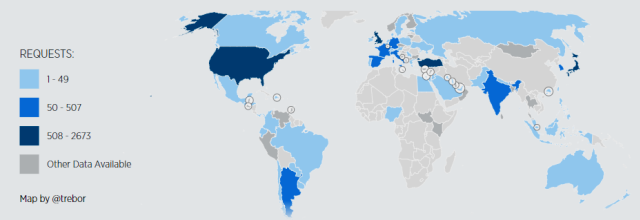
In the first six months of 2017, 90 percent of all removal requests to Twitter came from just four countries: Turkey, Russia, France and Germany:
Infographic: Turkish Authorities Top For Twitter Censorship  | Statista Source: Statista.com

The latest Transparency Report from Twitter ( $TWTR), also revealed which national governments have sent the most requests for users' information in the first half of 2017(see chart below). By a large margin, the United States is at the top of the list. Of the 2,111 account information requests made, Twitter responded 77 percent of the time with at least some data. A total of 4,594 accounts were specified in the requests. And while Turkey made 554 requests, on no occasion did Twitter produce information for ErdoÄŸan's government. Twitter's compliance rate varies significantly between countries. In the top ten list above, Italy had the most success with a rate of 78 percent, compared to India with just 21 percent, and Turkey with 0 percent.
Infographic: The Governments Making the Most Twitter Information Requests | Statista Source: Statista.com

For more see the interactive Twitter map | twitter.com:
transparency.twitter.com map
On the other hand, Twitter has gone from bastion of free speech to global censor | BusinessInsider.com--#TwitterCensorship:


feedback & comments via twitter @DomainMondo


DISCLAIMER

2017-03-01

Digital Winners and Losers: What Winning Brands Have In Common (video)

What Benjamin Button and Winning Brands Have In Common

(Editor's note: Please note language in video at 2:37 to the end may be offensive to some readers.)

Video above published on Feb 23, 2017 by L2inc.com:  NYU Stern Marketing Professor Scott Galloway on digital winners and losers:

Winner: Firms whose products become more valuable with use--SalesForce.com, Facebook.com, Amazon.com, Priceline.com, Redhat.com, TripAdvisor.com, Alphabet (Google.com),-- a trait shared by most of today's top-performing companies. In contrast, old-economy successes including Ford and Caterpillar produce items that decline in value.

Winner: Facebook Messenger. With a third of Americans on the platform, brands that haven't yet launched chat bots may be missing a major opportunity.

Loser: Twitter. Despite the engagement boost from Trump's controversial missives, the platform barely gained any monthly users in Q4 - prompting Twitter to start counting daily users instead.

Plus: does (Netflix) cheating count when the other person is asleep?

Unedited Transcript via YouTube.com:
0:00  a winner the Benjamin Button economy
0:04  that 13 companies in the S&P 500 beat
0:07  the S&P average five years running
0:10  showing that we are in fact in a
0:11  winner-take-all economy what is Benjamin
0:15  Button companies have in common they age
0:17  reverse their products become more
0:19  valuable with use every time you're on
0:22  Facebook the core platform becomes more
0:24  useful when you turn on ways it adds
0:26  additional utility to people's traffic
0:28  patterns yesterday's economic Titans for
0:31  Procter & Gamble caterpillar produce
0:34  products that decline in value
0:35  perishable with use the other group of
0:39  terms that are winning are the ones
0:40  caring for the ages specifically firms
0:42  that are cutting costs for old economy
0:44  firms we have two sets of winners
0:47  companies that age in reverse and those
0:50  that are caring for the ages a winner
0:52  facebook Messenger I don't nothing about
0:54  messenger if you have any insight into
0:56  the platform please message me on
0:58  another platform with one in three
1:00  Americans using facebook Messenger
1:02  one-in-three the platform represents a
1:05  major opportunity for brands eighty-one
1:07  percent of brands we track Adele to
1:08  allow customers to message the brand on
1:11  Facebook the most brands have not tapped
1:13  to the message was real potential just
1:15  2% are leveraging chat BOTS early
1:19  adopter sephora is using box so
1:21  customers can book in-store appointments
1:23  mcallen spots help users choose a
1:26  whiskey and bud light spot reminds users
1:28  when it's time for a beer during begin a
1:31  loser Twitter despite the engagement
1:33  boots from Trump's controversial missus
1:35  Twitter angel 2 million monthly users in
1:38  comparison facebook increased by 72
1:41  million what you do in the metrics don't
1:43  go your way
1:44  change the metric following snapchats
1:46  lead twitter now reports daily active
1:49  users and their fourth quarter earnings
1:51  call Twitter highlighted its daily
1:53  active user base increase of eleven
1:55  percent year-on-year while monthly users
1:57  only grew four percent
1:59  however unlike snapchat the firm has not
2:02  disclosed its total number of daily
2:04  users a continued winner netflix we
2:07  believe will be the fifth Horseman
2:09  almost half of couples who watch netflix
2:11  together have cheated on each other by
2:13  watching episode ahead of their partner
2:15  according to a new survey 25-percent of
2:18  cheating happens when one partner
2:20  faultlessly however half of respondents
2:22  they sleep cheating doesn't count i have
2:25  connected my uber app to my amazon alexa
2:27  to my network now and when it says play
2:30  next episode
2:31  I just need to run and automatically a
2:34  guy named hey-zeus takes a person next
2:37  to me and their sh*t away from me within
2:39  seven minutes or just thirteen dollars
2:41  and fifty eight steps
2:43  Who am I kidding i watch netflix alone i
2:47  do get lonely one of my most alone when
2:49  do I feel most alone when I'm around
2:52  other people who are total f*cking
2:54  idiots will get you now
2:59  [Music]

feedback & comments via twitter @DomainMondo


DISCLAIMER

2016-10-11

Incompetent ICANN Struggles With Its Domain Names Marketplace Index

ICANN Timeline: gTLD Marketplace Health Index 1.0 Work Plan [Draft]
Three years of close observation of ICANN leads one to the inescapable conclusion to never underestimate the incompetence of ICANN management and staff when it comes to domain names. Why ICANN would be creating hundreds of new gTLDs (new generic top-level domains) when it obviously has little or no real understanding of the domain name marketplace, is beyond comprehension. Search ICANN.org for its Marketplace Index--https://www.icann.org/search/#!/?searchText=Marketplace Index--and you may find the following:
September 6, 2016: Comment from John Poole, Editor of DomainMondo.com, and domain name registrant, Re: ICANN's gTLDMarketplace Health Index (Beta): Call for Comments
1. I repeat and incorporate by reference, as if fully set out herein, the entirety of mycomment found here: https://forum.icann.org/lists/comments-gtld-marketplace-health-17nov15/pdfQsziB8ArJy.pdf submitted on January 8, 2016, in response to your earlier gTLDMarketplace Health Index Proposal: Call for Comments. You have ignored not only my earlier comment referenced above, but most of the other comments submitted at that time, including comments by ICANN's own Business Constituency and IPC, all of which can be read here: https://forum.icann.org/lists/comments-gtld-marketplace-health-17nov15/. 
2. Your gTLD Marketplace Health Index (Beta) is severely flawed and should not be used. You have failed to define the "marketplace" properly, you have ignored "pricing" as a key component of determining "Marketplace Health" (you should be tracking, and publishing daily, wholesale and retail pricing, as well as corresponding registration numbers, for each and every TLD in the global DNS if you are indeed interested in "Marketplace Health"). You are measuring such metrics as "geographic diversity" which may be irrelevant or invalid for reasons I discussed in my earlier comment and which your "expert" ProfessorHemant Bhargava also cited. We live in a global economy. GoDaddy and other registrars do business worldwide via the internet. Wake up ICANN, it's the 21st Century! (Get out of your "hub" mentality and into a "global" mentality.) 
3. It appears ICANN management and staff are too incompetent, inept, or conflicted, to develop a useful, relevant and valid domain names "Marketplace Health Index." I would suggest taking note of all the comments submitted previously and this time, and outsourcing the entire project to CENTR https://www.centr.org/ and/or the Internet Society http://www.internetsociety.org/ or some other entity competent to do the job.
--Respectfully submitted, John Poole, Editor of DomainMondo.com, and domain name registrant
Read all the other comments submitted here, but note particularly, the comment (pdf) prepared by Andrew Simpson, Principal Data Scientist, Verisign, embedded in full below, which begins with the following "Summary":
"ICANN has decided to move forward with creating the Beta Marketplace Health Index but has not yet created a meaningful dialog that would permit a consensus to be reached among various stakeholders impacted by the index. Thus far, ICANN has requested public comment on their initial gTLD Marketplace Health Index Proposal. Following this initial round of comments, ICANN convened an advisory panel where they presented a revised draft to the panelists who each individually sent additional feedback to ICANN. ICANN did not disclose to the members of the advisory panel how the feedback that panelists provided would be addressed. Instead, ICANN’s staff seems to have relied solely on recommendations from its funded research, which was edited and reviewed by ICANN staff alone. The resulting Beta report therefore lacks clarity around goals – as noted in the community feedback -- and continues to arbitrarily define an industry marketplace that does not reflect end users’ experience nor the actual marketplace in which TLDs compete." (emphasis added)
Simpson goes on to note: 1) further refinement of goals is necessary (robust competition, thriving/fair marketplace); 2) Marketplace Scope needs to be expanded--"gTLDs and ccTLDs coexist in the eyes of end users"; 3) The process needs to be clearly defined;  and in regard to Marketplace Stability and Trust (emphasis added):
"The ambiguity of the current definition allows one to conclude that the metrics are measuring whether ICANN has created a stable set of vendors that it [ICANN] can trust. If the desired goal is to evaluate the perspective of any others in the marketplace, such as domain name users, then the metrics need to be changed to be far more comprehensive."
 So where is the Marketplace Index project going now? Best guess is here:

gTLD Marketplace Health Index 1.0 Work Plan [October 3, 2016 Draft]:
  • (26 October) Advisory Panel Meeting 1–Overview of next steps, discussion of scope and definitions, high-level issues
  • (Nov 3-9 exact date/time TBD): ICANN57 community session-project overview and request for feedback
  • (Nov 3-9 exact date/time TBD): ICANN 57 Advisory Panel working meeting (Topics likely overall scope, metrics category definitions)
  • (12/1 (exact date TBD)): Advisory Panel meeting-finalize discussion of scope and definitions
  • (Week of 5, 12 Dec) Staff–develop discussion list of proposed v 1.0 metrics for discussion with Advisory Panel
  • (Approx 16 Dec): AP call–overview of proposed v. 1.0 metrics
  • (19 Dec-17 January Lag for holiday break, AP review and feedback
  • (18-31 January) AP meetings, feedback period on "robust competition" metrics
  • (1 Feb-14 Feb) AP meetings, feedback period on "marketplace stability" metrics
  • (15-28 Feb) AP meetings, feedback period on "trust" metrics
  • Face-to-Face meeting at ICANN58-March 2017
  • (22-28 March) Finalize metrics list for 1.0
  • (end March/early April) draft/publish RFP for data source, if required

Comment by Andrew Simpson, Principal Data Scientist, Verisign, submitted Sep 9, 2016:


feedback & comments via twitter @DomainMondo


DISCLAIMER

2016-09-12

Why Users & Wall Street Are Not So Hot on Apple's New iPhones (videos)

Why Apple's New iPhones May Disappoint Fans:

Apple--NASDAQ: AAPL | apple.com--is breaking its own habit. Typically even-numbered year (like this one) mean a dramatically different new iPhone model. But the newest iPhones -- "iPhone 7" and "iPhone 7 Plus" -- are not major departures. Bloomberg Gadfly's Shira Ovide explains why Apple fans will have to wait another year for that "wow" product. (Source: Bloomberg, published September 6, 2016)

Why Wall Street's Not So Hot on Apple's New iPhone:

"Bloomberg West' segment with host Emily Chang streamed live on Thursday Sep 8, 2016. Commentators include Benedict Evans of Andreessen Horowitz (a16z.com).

Apple $AAPL stock chart (9/5-9/9):


feedback & comments via twitter @DomainMondo


DISCLAIMER

2016-06-21

EFF Calls for a Day of Action June 21 on Rule 41 Proposal

 NoGlobalWarrants.org
NoGlobalWarrants.org
Email received by the Editor of Domain Mondo from the Electronic Frontier Foundation (EFF.org):

EFF, the Tor Project, and dozens of other organizations concerned about the future of our digital security are taking a stand for users everywhere. We’re organizing a campaign and day of action to speak out against the changes to Rule 41.

Here's the deal: The Department of Justice is using an obscure procedure to push through a rule change that will greatly increase law enforcement’s ability to hack into computers located around the world. It’s an update to Rule 41 of the Federal Rules of Criminal Procedure. If Congress does nothing, this massive change will automatically go into effect on December 1. We’ve written a detailed explanation of the changes to Rule 41, which explains why this update will result in a dramatic increase in government hacking.

But we can’t do it alone. If you run a website, we need your help.

We’ve put together an embeddable banner to allow people to email members of the U.S. Congress or sign a petition opposing the changes to Rule 41. Please, check out the instructions for embedding the banner directly or hosting your own copy. The code will automatically display the banner on our day of action—Tuesday, June 21—and then disappear automatically.

If you plan to take part, please let us know.

Don't run a website?

Even if you don’t run a website where you can embed the banner, you can still help. On or before June 21, you can send an email to your member of Congress. Please post about Rule 41 on social media or a blog, and ask your friends to speak out. Feel free to get creative by hosting events in your home community, taking a photo, and sending it our way. And if you do plan something, please let us know!

Thanks for your help,

Rainey Reitman
Activism Director
Electronic Frontier Foundation
Support our work.


feedback & comments via twitter @DomainMondo


DISCLAIMER

2016-06-02

2016 Internet Trends Report, Smartphone Growth Slowing, Video & Slides

UPDATE Video: Internet trends report presented by Mary Meeker, KPCB, Code Conference 2016:

Kleiner Perkins Caufield & Byers partner Mary Meeker delivers her annual internet trends report. She says "easy growth is behind us" as the newest internet users are coming from less developed and less affluent countries. Meeker also delves into artificial intelligence, Snapchat brand integrations, changes to live sports viewing habits, car industry innovation and the rise of millennial consumers, among many other topics. Published June 1, 2016


2016 edition of Mary Meeker’s (KPCB) annual Internet Trends report (slides above). 3 Billion global Internet users, growth flat at 9% Y/Y, 7% Y/Y excluding India. Global smartphone user growth slowing, as are smartphone shipments.

KPCB Report offers an in-depth look at the following:

• Global Internet users have surpassed 3B; India, not U.S., is the world’s second-largest Internet market.

• Internet user growth flat (led by acceleration in India), while smartphone user and shipment growth have slowed.

• In the face of a slowing global economy, key macro growth drivers from the past 2 decades are less certain.

• Internet advertising (particularly via mobile) continues to grow, but so does ad-blocking, pushing the envelope on development of more innovative ad formats.

• New online-first brands have rapidly grown in popularity for the millennial generation with their focus on omni-channel and personalized distribution strategies.

• In communication, video and images shared are growing as a means of storytelling; creators, consumers, and advertisers are taking part.

• Messaging has evolved from simple, expressive conversation to business-focused use cases, with Asian platforms often leading the way.

• More efficient and often more convenient than typing, voice-based interfaces are ramping quickly and creating a new paradigm for human-computer interaction.

• Transportation is being re-imagined, as the rise of car computerization, autonomous driving, and sharing transform our understanding of mobility.

• Looking to China, Internet leadership continues, as the country boasts global innovation powerhouses in e-commerce, messaging, travel, financial services, and on-demand transportation.

• The proliferation of data generated by a multitude of devices has fostered tremendous business opportunity, but privacy concerns abound.


feedback & comments via twitter @DomainMondo


DISCLAIMER

2016-02-04

ICANN, DNS Abuse, New gTLDs: Bad Policy, Horribly Implemented

DomainMondoShiningLight ©2013domainmondo.com All Rights Reserved
ICANN Questionnaire: Measuring DNS Abuse in New gTLDs:
[note: first 5 questions not included as they only asked for contact information of the person answering the questionnaire]

ICANN is seeking input on the effectiveness of nine safeguards put in place prior to the launch of the New gTLD Program that are intended to mitigate abusive, malicious and criminal behavior in the Domain Name System. In particular, ICANN is looking for ways to measure the effectiveness of these safeguards, which include:
  1. Vetting registry operators
  2. Requirement for DNSSEC deployment
  3. Requirement for Thick WHOIS records
  4. Prohibition of “wild carding”
  5. Removal of orphan glue records
  6. Centralization of Zone file access
  7. Abuse contact and documented anti-abuse policy requirements for registries and registrars
  8. Availability of expedited registry security request process
  9. High-security zone verification
Please answer the questions below to the best of your knowledge and from your own perspective.

6. Which activities do you consider to be DNS abuse?

Answer: Launching hundreds of unwanted, unneeded new gTLDs into the global DNS has to be DNS abuse problem #1 of which the known perpetrator is ICANN itself (along with a few hucksters hoping to make money by exploiting trademark owners and domain name registrants generally), while the victims are businesses, registrants, and the entire global internet community. What has been the effect of ICANN's new gTLDs? Financially failing gTLDs, predatory pricing, malware, rampant cybercrime and trademark infringement, "shady" new gTLDs that "fail to work as expected on the internet" (universal acceptance, collisions, etc.), resulting in reputable security firms advising their clients to block new gTLDs "wholesale" in order to protect the safety, stability, and security of their networks and users.

7. If you could put forth a globally accepted definition of DNS abuse, what would it be? This definition should be broad enough to cover various malicious uses of the DNS.

Answer: Misuse and abuse of the global domain name system (DNS) by ICANN, TLD registry operators, registrars, registrants, or others having access to the DNS.

8. In your opinion, what are the most effective methods to measure the prevalence of abusive activities in the DNS?

Answer: Measure which TLDs are being blocked "wholesale" by network administrators and others globally for reasons of safety and security. Also measure which registry operators, registrars and registrants are connected to domains identified as having abusive activities. Contact firms like IID and Blue Coat to help ICANN staff begin to "understand and comprehend" the magnitude of the problem ICANN has created with its new gTLDs program, and the damage being inflicted upon the DNS and global internet community. ICANN's new gTLDs program is an example of "bad policy, 'horribly implemented.'"

9. As part of the New gTLD Program, ICANN introduced safeguards to mitigate potential DNS abuse in new gTLDs (listed above). How would you propose we measure the effectiveness of these safeguards?

Answer: Since ICANN itself is a source of the problem--see answer to #6 above--accordingly, "ICANN safeguards" were insufficient and ineffective from the start. If ICANN never had a clue how to measure the effectiveness of its own safeguards, ICANN should have never introduced new gTLDs.

10. What has been your experience, personally or on behalf of an organization, with these safeguards? Please tell us:
A. Which were and/or were not effective? How so and why do you believe they were or were not effective?
B. Are there safeguards that should have been included but were not?

Answer to 10A&B: My experience has been as a user of the internet, domain name registrant, and website developer/publisher/editor. ICANN's "safeguards" were ineffective and insufficient--see answers to #6, #7, #8, #9 above. ICANN's new gTLDs program--bad policy, horribly implemented--is a complete indictment of ICANN and its own peculiar form of the "multistakeholder model" of internet governance.

Submitted to ICANN February 1, 2016

See also on Domain Mondo:


DISCLAIMER

2015-12-08

Blocking New gTLDs, ICANN's 'Shadiest' Top-level Domains, 'Wholesale'

"ICANN is not a regulator and we have limited expertise or authority to assess the legality of ... [a new gTLD registry operator's] activities."- Allen Grogan, ICANN Chief Contract Compliance Officer, 09 Apr 2015 (emphasis added)
For internet users, safety and security on the web is becoming more and more problematic due, in part, to ICANN's money-grab, the new gTLDs program, which unleashed hundreds of unwanted and unneeded new gTLDs (new generic top-level domains) onto the internet without any regulatory oversight from internet authority ICANN, or otherwise. The results have been dismal, for internet users and the domain name industry:
“Most new gTLDs have failed to take off and many have already been riddled with so many fraudulent and junk registrations that they are being blocked wholesale,” said IID President and CTO Rod Rasmussen recently.
The answer? Other than being sure your OS and Browser are updated and utilizing all security features available, consider blocking ICANN's 'shadiest' new gTLDs "wholesale" as indicated by IID's Rod Rasmussen, who, according to IID's website, is:
"... Co-chair of the Anti-Phishing Working Group’s (APWG) Internet Policy Committee and serves as the APWG Industry Liaison, representing and speaking on behalf of the organization at events around the world ... and is a member of ICANN's Security and Stability Advisory Committee (SSAC). Rasmussen is a member of the Online Trust Alliance’s (OTA) Steering Committee. He is a member of the FCC's Communications Security, Reliability and Interoperability Council (FCC CSRIC) ..."
And IID is hardly alone among respected security firms:

The shadiest characters in the world of top-level domains | ZDNet: "In order to safeguard themselves against unwanted, suspicious traffic, Blue Coat recommends that the enterprise consider blocking traffic which leads to the riskiest top-level domains, and users should take caution against linking [or clicking] on links based on these TLDs if received over email or social networks." (emphasis, and link added)

How to block new gTLDs, or any Top-Level Domain, be it a gTLD or ccTLD, so your computer, smartphone, tablet or other device is not infected with malware, hijacked, etc.? Network administrators and even nations (see, e.g., China's Great Firewall), can block TLDs 'wholesale.' For individual users, it depends.

Using OpenDNS is one answer for individual users to protect themselves from ICANN's shadiest new gTLDs--see Block .xxx .info etc.. : OpenDNS: "You can already block any domain you want, including the TLDs you mentioned, by adding them to your blacklist." 

A list of ALL top-level domains (TLDs) is here--be sure to allow legacy gTLDs .COM, .NET, .ORG, (and if you are in the U.S., also .EDU, .GOV, .MIL), and the ccTLD of your country.

More options for blocking 'wholesale' all of ICANN's shady new gTLDs, as well as other 'bad news' TLDs, will likely emerge in response to the warnings issued by respected security firms such as IID and Blue Coat, as well as due to increasing public demand for safety, security, consumer protection, and consumer choice on the internet!

Caveat Emptor!

See also on Domain Mondo:


DISCLAIMER

2015-11-04

ICANN, Domain Industry, Special Interests, and the Global Public Interest

Background: The NETmundial Multistakeholder Statement says the “Internet is a global resource which should be managed in the public interest.” Resolutions appended to the ITU’s core treaties say that IP-based networks must be interoperable and globally reachable in the public interest, and that governments must provide a clear legal framework “to ensure adequate protection of public interests in the management of Internet resources, including domain names and addresses.” ICANN’s Bylaws and Affirmation of Commitments employ the term three and five times, respectively. ICANN’s GAC has invoked the term to justify some of its positions, and applicants for new gTLDs are asked to undertake Public Interest Commitments. But what does the “public interest” really mean with respect to critical Internet resources? There has been no collective effort to clarify the standard to be followed. ICANN’s new Strategic Plan prioritizes developing ”a common consensus based definition of public interest” for the organization.--see description of IGF 2015 Workshop No. 52, The Global “Public Interest” in Critical Internet Resources (emphasis added)

Context: CCWG-Accountability--Cross Community Working Group on Enhancing ICANN Accountability--from its public mail list, November 2, 2015 (emphasis added):

Trying to come up with a definition of "global public interest", whether by the Board, the Community or the Sole Designator (?) seems like an effort that will either be endless or perilous. Baking it into the Bylaws seems like an awful idea.--Greg Shatan, President, IPC

I agree, this could lead us down a very tortured path.--J. Beckwith Burr

As a point of information, ICANN’s Development and Public Responsibility Department (DPRD) has already started conversations within the community on how to define “public interest” within ICANN, with the anticipation that this multistakeholder definitional work will proceed in earnest soon.  This has been forecast in ICANN’s Strategic Plan.--Samantha Eisner, ICANN Staff Attorney

ICANN--the Internet Corporation for Assigned Names and Numbers--and the Public Interest: a Contradiction in Terms?

"ICANN is an organization rooted in the private sector (including civil society) with governments in an advisory capacity. In the Affirmation of Commitments of 2009, ICANN committed itself to act in the global public interest. ICANN is a bottom-up organisation which has its origins in one country and is driven by a community that is dominated by the domain industry and other special interests. So it is not always easy to ensure that the decisions taken by ICANN are in the global public interest. But more and more people in ICANN have realised that efforts should be strengthened to increase the diversity of stakeholders in ICANN so that more diverse interests are better represented. It is also the role of governments in ICANN to make sure that a minimum level of diversity of views is brought in to ICANN and that a good balance is struck between different special interests so that, in the end, something like a globally aggregated public interest can be identified. In addition, a discussion has started in ICANN about how to better understand the notion of global public interest and how to improve its accountability mechanisms so that the global public interest is better reflected in its decisions. There is still much work ahead, but ICANN’s current efforts are going in the right direction." -- Thomas Schneider, Swiss cyber-diplomat and the Chairman of ICANN's Governmental Advisory Committee (GAC); Geneva Digital Watch: Issue 5, November 2015 (pdf),(links and emphasis added).

Affirmation of Commitments by the United States Department of Commerce (DOC) and the Internet Corporation for Assigned Names and Numbers (ICANN), September 30, 2009: “ … This document affirms key commitments by DOC and ICANN, including commitments to: (a) ensure that decisions made related to the global technical coordination of the DNS are made in the public interest and are accountable and transparent; (b) preserve the security, stability and resiliency of the DNS; (c) promote competition, consumer trust, and consumer choice in the DNS marketplace; and (d) facilitate international participation in DNS technical coordination … DOC affirms its commitment to a multi-stakeholder, private sector led, bottom-up policy development model for DNS technical coordination that acts for the benefit of global Internet users. A private coordinating process, the outcomes of which reflect the public interest, is best able to flexibly meet the changing needs of the Internet and of Internet users. ICANN and DOC recognize that there is a group of participants that engage in ICANN's processes to a greater extent than Internet users generally. To ensure that its decisions are in the public interest, and not just the interests of a particular set of stakeholders, ICANN commits to perform and publish analyses of the positive and negative effects of its decisions on the public, including any financial impact on the public, and the positive or negative impact (if any) on the systemic security, stability and resiliency of the DNS … a multi-stakeholder, private sector led organization with input from the public, for whose benefit ICANN shall in all events act… ICANN commits to maintain and improve robust mechanisms for public input, accountability, and transparency so as to ensure that the outcomes of its decisionmaking will reflect the public interest and be accountable to all stakeholders … ensuring that ICANN is acting transparently, is accountable for its decision-making, and acts in the public interest …. “

Public Interest: Anything affecting the rights, health, or finances of the public at large. 

Public interest is a common concern among citizens in the management and affairs of local, state, and national government. It does not mean mere curiosity but is a broad term that refers to the body politic and the public weal. A public utility is regulated in the public interest because private individuals rely on such a company for vital services. (source: West's Encyclopedia of American Law, edition 2. S.v. "Public Interest." legal-dictionary.thefreedictionary.com)

The Institute of Chartered Accountants in England and Wales argues that applying a detailed definition [of "Public Interest"] is likely to result in unintended consequences, in Acting in the Public Interest (2012). Instead, each circumstance needs to be assessed based on criteria such as the relevant public, wants, and constraints. The key to assessing any public interest decision is transparency of the decision-making process, including balancing competing interests. (Wikipedia)

Meaning of public interest | ALRC | Australian Law Reform Commission: "... Should public interest be defined?
8.35 ‘Public interest’ should not be defined, but a list of public interest matters could be set out in the new Act. The list would not be exhaustive, but may provide the parties and the court with useful guidance, making the cause of action more certain and predictable in scope. This may in turn reduce litigation.
8.36 In Hogan v Hinch, French CJ stated that when ‘used in a statute, the term [public interest] derives its content from “the subject matter and the scope and purpose” of the enactment in which it appears’. 8.37 In the UK, the Joint Committee on Privacy and Injunctions concluded that there should not be a statutory definition of the public interest, as ‘the decision of where the public interest lies in a particular case is a matter of judgment, and is best taken by the courts in privacy cases’.
8.38 Including a non-exhaustive list of public interest matters seems more helpful than a definition of public interest, which might necessarily have to be overly general or overly confined and inflexible...."

See also: The Global “Public Interest” in Critical Internet Resources | DigitalWatch: notes from an IGF2015 session and YouTube video of that session. Domain Mondo's notes: Larry Strickling suggested "framing" or public interest described via a series of attributes. Others: public interest contrasted with naked private interests or interests of private gain; Framework of Principals; Right Participation in making decision; and Definitions vs Examples.


DISCLAIMER

Domain Mondo archive