Showing posts with label Markets. Show all posts

2019-03-20

Federal Reserve Chairman's Press Conference LIVE Wednesday, March 20

FOMC Press Conference LIVE March 20, 2019, 2:30pm EDT

FOMC Press Conference LIVE March 20, 2019, at 2:30 pm EDT, with the Fed Chair, following FOMC Meeting associated with a Summary of Economic Projections. Summary: no rate-hikes in 2019, one rate-hike in 2020, and balance sheet normalization ends in September.

See also March 20, 2019 Balance Sheet Normalization Principles and Plans.

Domain: federalreserve.gov
Effective Federal Funds Rate--Above: Jul 1954 - Feb 2019
The Federal Open Market Committee (FOMC) consists of twelve members--the seven members of the Board of Governors of the Federal Reserve System; the president of the Federal Reserve Bank of New York; and four of the remaining eleven Reserve Bank presidents, who serve one-year terms on a rotating basis. The rotating seats are filled from the following four groups of Banks, one Bank president from each group: Boston, Philadelphia, and Richmond; Cleveland and Chicago; Atlanta, St. Louis, and Dallas; and Minneapolis, Kansas City, and San Francisco. Nonvoting Reserve Bank presidents attend the meetings of the Committee, participate in the discussions, and contribute to the Committee's assessment of the economy and policy options.
The FOMC holds eight regularly scheduled meetings per year. At these meetings, the Committee reviews economic and financial conditions, determines the appropriate stance of monetary policy, and assesses the risks to its long-run goals of price stability and sustainable economic growth.
2019 FOMC Members:
Alternate Members:

Fed Chairman Powell at FOMC Press Conference January 30, 2019

feedback & comments via twitter @DomainMondo


DISCLAIMER

2018-12-19

Federal Reserve Chairman's Press Conference LIVE Wednesday, Dec 19

FOMC Press Conference LIVE December 19, 2018

"In view of realized and expected labor market conditions and inflation, the Committee decided to raise the target range for the federal funds rate to 2-1/4 to 2-1/2 percent."--FOMC Press Release, Dec 19, 2018 (pdf). Voting for the FOMC monetary policy action were: Jerome H. Powell, Chairman; John C. Williams, Vice Chairman; Thomas I. Barkin; Raphael W. Bostic; Michelle W. Bowman; Lael Brainard; Richard H. Clarida; Mary C. Daly; Loretta J. Mester; and Randal K. Quarles. See also Implementation Note issued December 19, 2018.

FOMC Meeting December 18-19. 2018The Federal Reserve's highly-anticipated December Federal Open Market Committee (FOMC) meeting, Tuesday-Wednesday, December 18-19, 2018. Consensus of economists is that the Fed will raise interest rates by a quarter-point to a range of between 2.25% and 2.50% and that the Fed's closely-watched dot plot will indicate two rate hikes in 2019. Any indication of the Fed's plans for the future may have an even greater impact on markets and many analysts will closely follow the LIVE press conference of Federal Reserve Chairman Jerome Powell, at 2:30 p.m. EST, Dec 19, 2018. Fed drift” is a known market anomaly, where the S&P 500 often generates most of its annual return in the 3 days around Federal Reserve meetings.
On Monday, DoubleLine Capital CEO Jeff Gundlach told CNBC-TV that the Federal Reserve should not hike its benchmark overnight lending rate in December. "I think they shouldn't raise them this week. The bond market is basically saying, 'Fed you've got no way you should be raising interest rates,"  said Gundlach.
The Federal Open Market Committee (FOMC) consists of twelve members--the seven members of the Board of Governors of the Federal Reserve System; the president of the Federal Reserve Bank of New York; and four of the remaining eleven Reserve Bank presidents, who serve one-year terms on a rotating basis. The rotating seats are filled from the following four groups of Banks, one Bank president from each group: Boston, Philadelphia, and Richmond; Cleveland and Chicago; Atlanta, St. Louis, and Dallas; and Minneapolis, Kansas City, and San Francisco. Nonvoting Reserve Bank presidents attend the meetings of the Committee, participate in the discussions, and contribute to the Committee's assessment of the economy and policy options.

The FOMC holds eight regularly scheduled meetings per year. At these meetings, the Committee reviews economic and financial conditions, determines the appropriate stance of monetary policy, and assesses the risks to its long-run goals of price stability and sustainable economic growth.

Federal Reserve Chairman Jerome Powell at his FOMC Press Conference September 26, 2018
2018 FOMC Committee Members:
Alternate Members:


feedback & comments via twitter @DomainMondo


DISCLAIMER

2018-11-07

Election 2018 LIVE, US Senate and House Results Could Affect Markets

FRANCE 24 Live

France 24 LIVE (in English). See also New York Times Election Results LIVE: House and Senate.


feedback & comments via twitter @DomainMondo


DISCLAIMER

2018-09-19

Buy or Sell Stocks? Nobody Understands the Stock Market (videos)

One View: "Wall Street Is Probably Too Optimistic on Stocks, Sell Now"

"Investing Strategies - Morning Jolt" video above published by TheStreet.com Sep 18, 2018: Sell now, ask questions later?

"The Reality" according to TheStreet.com's Brian Sozzi, who is bearish, in the video above: "Within a week, two industrial powerhouses have let investors down with their profits. Investors have to start paying attention. 3M warned last week on profits amid higher commodities costs. FedEx missed earnings forecasts on Monday by a whopping 34 cents thanks to investments in higher worker wages."

Fund Managers Say: A net 24% of investors surveyed by BofA expect global growth to slow in the next year, up from net 7% in August. It marked the worst outlook on the global economy since December 2011. Editor's note: this may, in fact, be a bullish sign for buying more U.S. stocks as the large U.S. domestic market is not as dependent on exports as say, China or Germany. In that case,  Wall Street's bull market may be "where the action is" among global equity markets for the foreseeable future, and may have a lot more life left in it. U.S. stock exchanges are still getting plenty of domestic, as well as many, if not most, of the best non-domestic tech listings and IPOs, including from Europe (e.g., Spotify $SPOT) and China.

Market tops usually come when greed has fully displaced fear (which is not the case today), one reason why almost everyone, including the Federal Reserve, didn't see the 2008 crisis coming.

Around The Street: Over on Real Money, TheStreet.com's Jim Cramer tackled why nobody cares about high valuations on stocks. "What's so frustrating, what's so maddening about this market right now, though, is that valuation makes no difference whatsoever in anyone's thinking. Anyone. You get these downgrades by analysts on valuation and you just roll your eyes because, you see -- and this is really the rub -- the buyers do not care. They aren't going to stop here. They get new money in, they look at their stocks, they think their stocks are cheap and they buy more of them. It's an insanely non-rigorous virtuous circle. You want to boil down the current investment thesis? It goes like this: I buy them because they go higher and they go higher because I buy them. Could there be a more stupid or a more profitable investment strategy at this moment -- and perhaps until the end of the year? I don't know. I can't think of one," Cramer said.

Editor's note: end of the year? It could run a lot longer than that--Trump wants a trillion-dollar infrastructure program--and may get the OK from Congress next year, with help from Democrats. Remember,Trump is a real estate developer who was always very comfortable using leverage (debt).
NASDAQ Composite
Trade Wars and Tariffs? "Tariffs on another $200 billion will mean about 12% of U.S. imports have seen a tariff hike. That means an average tariff increase of only 1.6% across all imports, so tiny compared to the 1930s, when they were 20%," says Shane Oliver, chief economist at AMP Capital Investors (ampcapital.com)--Markets Shrug Off Fresh Trade Salvo | SeekingAlpha.com Sep 18, 2018.

Looking further into 2019, is Brexit: Friday, 29 March 2019. The UK economy is the fifth-largest national economy in the world measured by nominal gross domestic product (GDP), ninth-largest measured by purchasing power parity (PPP). The EU seems to be forcing UK into a "hard Brexit" which will only strengthen Trump's hand for a quick "Free and Fair" trade deal between the US and UK, which both Donald Trump and Theresa May say they want. The UK is a net importer from the EU, so the EU stands to be hurt more by a "hard Brexit" than the UK, and opening the UK's $3.028 trillion economy (GDP PPP) to U.S. goods and services will open to the U.S. a developed market 1½ times the size of Canada's (GDP PPP), and for the UK, opening the U.S. economy ($20.4 trillion) to UK goods and services, will more than replace the EU (minus UK), as a trading partner. In such a scenario, don't be surprised if Trump, ever the showman, gloats over the stupidity of Brussels and Merkel, with what one might describe as a "shock and awe" US-UK trade deal meant to embarrass and humiliate the EU overlords in Brussels. Unlike Mexico, the UK, as a US trading partner, does not present competitive problems of low wages, lax environmental rules, crime and corruption. There is no language barrier, and the financial systems of both countries are already closely linked.

Michael Lewis: Nobody Understands the Stock Market

Bloomberg.com video above published Apr 2, 2014: "Flash Boys: A Wall Street Revolt" Author Michael Lewis discusses his book, trading and the stock market on Bloomberg Television's "Market Makers."

Editor's note: unless you are a professional trader, hedge fund manager, etc., the above is a good reason why individual investors should stick with index funds, starting with VFIAX, VFINX, or the like.

On the other hand,  cryptocurrencies? Hope you got out:

-- John Poole, Editor  Domain Mondo 

feedback & comments via twitter @DomainMondo


DISCLAIMER

2018-08-28

Brian Lynch, Co-Founder and CEO, RegTek Solutions (video)

Tech Talk: interview with Brian Lynch, RegTek Solutions

TheBanker.com video above published Aug 13, 2018: Brian Lynch, co-founder and CEO, RegTek Solutions, talks to Joy Macknight about the state of play in terms of reporting obligations and the cost of compliance, and how ‘regtech’ is addressing the pain points. #RegTech

"At the heart of the market’s transformation to sustainable compliance."--RegTek Solutions
  • RegTek Solutions, Inc., New York, London
  • Domain: regteksolutions.com


feedback & comments via twitter @DomainMondo


DISCLAIMER

2018-08-22

Fintech Regulation in the UK: What It Can Teach The World (video)

Fintech Regulation in the UK: What It Can Teach The World

FT Transact (ft.com) video above published Aug 13, 2018: "The Financial Conduct Authority (FCA) (fca.org.uk) has won praise around the world with a so-called sandbox, where UK fintech companies can test products with temporary authorisation. Now, it's being widely copied and there are plans to start a global sandbox. It has even caught the eye of major players, with Microsoft urging the US regulator to be more like its UK counterpart. counterpart. But should we be worried that the twin forces of big tech and banking are now praising the body that is their watchdog?"

Project Innovate: fca.org.uk/firms/fca-innovate

See also: UK is expected to keep the door open for European Union banks and investors after Brexit--reuters.com.

"Through our Innovation Hub we want new and established businesses - both regulated and non-regulated - to be able to introduce innovative financial products and services to the market."--FCA


feedback & comments via twitter @DomainMondo


DISCLAIMER

2018-07-09

Trade War Begins: Why China’s Growth Doesn’t Work For America Anymore

President Trump Announces Trade Tariffs On China Imports

BloombergQuint.com video above published Jul 6, 2018.

Trump tariffs on Chinese goods fulfill campaign promise: Peter Navarro

White House Office of Trade and Manufacturing Policy Director Peter Navarro says President Trump has given China every possible avenue to address the theft of U.S. intellectual property. Fox Business video above published Jul 6, 2018.

Trade War Begins: Why China’s Growth Doesn’t Work For America Anymore

No longer does the United States see the Chinese system of economic growth as a tolerable process, says Law Professor Raj Bhala, an expert in International Trade Law, in the video above. Raj Bhala is the inaugural Brenneisen Distinguished Professor, The University of Kansas, School of Law, and Senior Advisor to Dentons U.S. LLP.

According to Bhala, two Trump administration documents detail why Section 301 actions are necessary:

The first is a 215-page investigation report, issued on March 22 by the United States Trade Representative (USTR), summarized in the USTR’s language:
  • “China uses joint venture requirements, foreign investment restrictions, and administrative review and licensing processes to force or pressure technology transfers from American companies.”
  • “China uses discriminatory licensing processes to transfer technologies from U.S. companies to Chinese companies.”
  • “China directs and facilitates investments and acquisitions which generate large-scale technology transfer.”
  • “China conducts and supports cyber intrusions into U.S. computer networks to gain access to valuable business information.”
The second is a 35-page report, issued on June 20 by the White House Office of Trade and Manufacturing (embed below), which contends that in addition to protectionist barriers, subsidized overcapacity, and cloud computing restrictions, China seeks to “acquire key technologies and intellectual property from other countries” and “capture the emerging high-technology industries that will drive future economic growth and many advancements in the defense industry.”


A third document is April 18 testimony to Congress by Pacific Commander Admiral Philip Davidson that the CCP’s military intentions in the South China Sea threaten to “displace the U.S. as the security partner of choice for countries in the Indo-Pacific” and “prevent the United States from intervening in any regional conflict on China’s periphery”.
"… [T]he United States advocates for a free and open Indo-Pacific, supported by regional partners and allies that respect international law, freedom of navigation and overflight, and the free flow of commerce and ideas. ...[I]t is increasingly clear that China wants to shape a world aligned with its own authoritarian model and inconsistent with these principles. Through coercive diplomacy, predatory economic policies, and rapid military expansion, China is undermining the rules-based international order. We must be willing to cooperate with China where we can, while consistently and unapologetically confronting China when it engages in behavior that undermines the international order or harms U.S. interests in the region."
Bhala says that on July 6, 2018, President Trump changed the U.S. narrative on trade with China. He imposed under Section 301 of the Trade Act of 1974, a 25 percent tariff on $35 billion worth of Chinese imports into the United States, effective July 6, with more levies possible, up to $500 billion on Chinese goods, and China immediately counter-retaliated.

According to Bhala, the U.S. will no longer facilitate Chinese economic growth because the U.S. no longer believes Chinese Communist Party (CCP) led planning is good for the U.S. or the world--that the CCP’s economic behavior, not to mention military intentions, erode America’s economic vitality and thereby undermine its national security. Bhala adds:

"The European Union fought most of the rest of the world over bananas throughout the 1980s and 1990s. Canada and the United States have been whacking each other with softwood lumber since 1982 ... The prudent historical inference for businesses to draw is to re-think their models.
  • Is there exposure to imports, exports, or foreign direct investment in China?
  • What alternative sources of supply exist?
  • Are alternative sales markets appealing?
  • Are alternative production venues viable?
"Even if, perchance, hostilities cease with a truce or treaty, the re-think will prove useful. That’s because the new narrative is a testament to enduring Chinese-American tensions." Read more by Bhala here.

See also:

feedback & comments via twitter @DomainMondo


DISCLAIMER

2018-05-30

MacroView | Forget Brexit, Fear of Italy Doing a EURO Exit Shakes Markets

UPDATE: Wall Street Climbs as Worries Over Italy's Politics Ease | NYTimes.com: May 30, 2018 12:32pm EDT.

Original post:
If you're in the U.S. and got back from your Memorial Day weekend late, you may be wondering, what happened to cause markets to tumble Tuesday? Here's a recap:

Italian president rejects nomination of Eurosceptic minister

Financial Times (ft.com) video above published May 27, 2018: Leaders of Italy's leading populist parties have dropped their bid to form a government after President Sergio Mattarella rejected their nomination of a Eurosceptic finance minister.

Dow Tumbles Nearly 400 Points; S&P 500 and Nasdaq Also Decline | TheStreet.com May 29, 2018: "Stocks fall sharply Tuesday as a political crisis in Italy rocks markets across the globe." Also: Investors are dumping Italian government debt | ft.com.


Italian bond yields are rising rapidly because the country is laden with debt and in political turmoil. TheStreet.com's Tracy Byrnes enlisted London Bureau Chief Martin Baccardax to help explain how it will affect the rest of us.
Germany's DAX
Who  is  was Carlo Cottarelli?

Financial Times (ft.com) video above published May 28, 2018: As newly appointed prime minister, the former IMF official will focus on improving Italy's finances ahead of new elections, but many think he will immediately face a vote of "no confidence" and some now think new elections may be scheduled as early as July, 2018--major parties in Italy say Cottarelli’s mission is 'all but dead' and parliament will soon be dissolved --Italy may return to polls in July, sources say, amid market rout | Reuters.com.
The MacroView:
Italy's new election could become a referendum on the European Union and the euro--President readies Italy for snap polls to be fought on EU, euro | Reuters.com--the far-right League and anti-establishment 5-Star Movement may unite for an upcoming new election in Italy. League leader Matteo Salvini said on Monday, May 28: “Today Italy is not free; it is occupied financially by Germans, French and eurocrats ... if there’s not the OK of Berlin, Paris or Brussels, a government cannot be formed in Italy. It’s madness, and I ask the Italian people to stay close to us because I want to bring democracy back to this country.” When? New elections in Italy 'by start of 2019' at the latest or as early as autumn: Italy's president named a former IMF economist Carlo Cottarelli as caretaker prime minister to lead the country into new elections, possibly as soon as the autumn in the eurozone's third largest economy.  Mr Cottarelli, 64, was director of the IMF's fiscal affairs department from 2008 to 2013 and became known as "Mr Scissors" for making cuts to public spending in Italy--rte.ie.

Most Exposed to Italy’s Sovereign Debt? (Other than Italian Banks): BNP Paribas, France’s largest bank, with €16 billion of Italian sovereign debt holdings, Dexia (French-Belgian) holds €15 billion of Italian debt, and Banco Sabadell has €10.5 billion invested in Italian bonds (40% of its entire fixed asset portfolio, worth €26.3 billion, and 110% of its tier-1 capital)--WolfStreet.com.

ECB & Eurozone: Banque de France to pursue efforts to spur consolidation of Europe's financial sector: Villeroy | Reuters.com--Editor's note: if consolidation is "encouraged," Europe may end up with a few (5 or 6?) large banks (mostly German or French) controlling the EU/eurozone financial sector. The five largest commercial banks in the U.S. had 44 percent of total assets in the banking system as of 2014 (most likely even more now). Unlike the U.S., however, Europe still has a lot of large "troubled" banks with underlying financial problems--consolidation now could exacerbate a situation the ECB has failed to remediate.

feedback & comments via twitter @DomainMondo


DISCLAIMER

2018-01-04

Blackstone's Byron Wien's 10 Surprises for 2018 (video)

Blackstone's Byron Wien's 10 Surprises for 2018

Bloomberg.com video above published Jan 3, 2018: Blackstone (domain: blackstone.com) Vice Chairman of Private Wealth Solutions Byron Wien discusses the market, economic, and political surprises he sees coming in 2018. He speaks on "Bloomberg Markets."

 S&P 500
 Euro to USD


feedback & comments via twitter @DomainMondo


DISCLAIMER

2017-12-26

Investors Warned By FINRA Not To Get Fooled By Bitcoin Scams (video)

Investors Warned Not To Get Fooled By Bitcoin  or Cryptocurrency Scams

CNBC.com video above published Dec 22, 2017: Bitcoin's skyrocketing stocks push cryptocurrency mania — and scams — to new highs, but FINRA's guidelines could help investors avoid getting duped.

See also:

FINRA Warns Investors: Don’t Fall for Cryptocurrency-Related Stock Scams | FINRA.org: "... "It can be difficult for investors to avoid the lure of the cryptocurrency markets, especially when prominent people express interest in it, and news reports and social media tout the promise of guaranteed quick fortunes and skyrocketing returns," said Gerri Walsh, FINRA’s Senior Vice President for Investor Education. "But it is important to do your research. Even when legitimate companies enter a hot, new sector, con artists almost always follow suit." Before investing in any cryptocurrency-related stock, buyers should follow these tips to avoid costly mistakes:
  • Be suspicious of anyone who guarantees that an investment will perform a certain way, or makes pushy sales pitches that encourage you to “act now.” If you think the claims might be exaggerated or misleading, contact the SEC, file a complaint using FINRA’s online Complaint Center or send a tip to FINRA's Office of the Whistleblower.
  • Do not say "yes" to cryptocurrency stock purchases from an aggressive cold caller, particularly if the recommended stocks are very low-priced. Not answering at all, or putting down the phone, are generally the safest responses to a cold caller or anyone aggressively pitching low-priced stocks or other investment opportunities.
  • Use FINRA BrokerCheck® to check the professional background of the individuals involved in selling the investment, as well as the firms who tout these opportunities. Selling securities generally requires a license and registrations under state and federal securities laws and FINRA rules.
  • Check the SEC's EDGAR database to find out whether the company files with the SEC. If so, read the reports and verify any information you have heard about the company. But remember, the fact that a company that has registered its securities or filed reports with the SEC doesn't mean it will be a good investment.
  • Be wary of stocks with huge spikes in price. Steep run-ups in price could signal potential manipulation or fraud.
  • Know where the stock trades and pay attention to any cautions associated with the stock. Most stock pump-and-dump schemes tend to be quoted on an over-the-counter (OTC) quotation platform like OTC Markets, which provides icons to warn investors of concerns associated with a given company. These include a stop sign or skull and crossbones to warn of questionable practices.
"Investors can obtain more information about, and the disciplinary record of, any FINRA-registered broker or brokerage firm by using FINRA's BrokerCheck or by calling (800) 289-9999. In 2016, members of the public used this free service to conduct 111 million reviews of broker or firm records. Investors can also call FINRA's Securities Helpline for Seniors at (844) 57-HELPS for assistance with concerns or questions about their brokerage accounts and investments ..."

In the U.S., the Financial Industry Regulatory Authority, Inc. (FINRA) (domain: finra.org) is a private corporation that acts as a self-regulatory organization (SRO). FINRA is the successor to the National Association of Securities Dealers, Inc. (NASD) and the member regulation, enforcement and arbitration operations of the New York Stock Exchange. It is a non-governmental organization that regulates member brokerage firms and exchange markets. The government agency which acts as the ultimate regulator of the securities industry, including FINRA, is the Securities and Exchange Commission (Domain: SEC.gov).

Similarly, the Commodity Futures Trading Commission (CFTC) is the U.S. financial regulatory agency tasked with overseeing the U.S. derivatives markets (domain: cftc.gov). Read the CFTC Statement on Self-Certification of Bitcoin Products by CME (cmegroup.com), CFE (cfe.cboe.com), and Cantor Exchange (cantorexchange.com).

The National Futures Association (NFA) is the industrywide SRO for the U.S. derivatives industry. Read NFA Investor Advisory—Futures on Virtual Currencies Including Bitcoin | nfa.futures.org:
"December 1, 2017 The purpose of this investor advisory is to remind investors that, just like any other speculative investment, trading futures on virtual currencies, including Bitcoin, have certain benefits and various risks. While futures on virtual currencies must be traded on regulated futures exchanges, trading these products involves a high level of risk and may not be suitable for all investors. It is critical, therefore, for investors who are considering trading virtual currency futures to educate themselves about these products, understand their risks, and conduct due diligence before making investment decisions. Investor protection begins with investor education ...." (read more at link above).


feedback & comments via twitter @DomainMondo


DISCLAIMER

2017-09-29

Catalonia Vote LIVE: a Black Swan for EU, ECB, Spain, Markets, Economy?

Catalonia Vote LIVE: a Black Swan for EU, ECB, Spain, Markets, Economy? | DomainMondo.com (graphic)
Black Swan"an unpredictable or unforeseen event, typically one with extreme consequences."--Wall Street and City of London Press Panic Button on Catalonia | WolfStreet.com: "Sometimes you have to keep the black swans in mind.” 
UPDATE 1 Oct 2017: Catalonia’s Dark Days Ahead | WolfStreet.com"It isn’t just about what happens on Sunday; it’s about the ensuing days and weeks."
LIVE France 24 English 24/7 video stream below:


UPDATES:
  • Oct 4: Catalonia to move to declare independence from Spain on Monday--Reuters.com
  • Oct 2: Reuters.com: European Commission says Catalan vote was not legal; Catalonia worries knock euro against stronger dollar--Reuters.com.
  • UPDATE Oct 1: Catalan referendum: Catalonia has 'won right to statehood'--BBC.com--Catalan leader Carles Puigdemont says the region has won the right to statehood following Sunday's contentious referendum which was marred by violence.
  • Catalonia Independence Referendum Vote, Sunday, October 1, 2017.
Catalonia shuts down in protest Oct 3

Financial Times (FT.com) video above published Oct 3, 2017.

How Did Things Get So Bad in Catalonia? | WolfStreet.comThe answer, to borrow from Ernest Hemmingway’s The Sun Also Rises, is “gradually, then suddenly.”

Catalonia's referendum explained (video):

Above video published by FT.com Sep 26, 2017. LIVE Twitter Feed:


feedback & comments via twitter @DomainMondo


DISCLAIMER

2017-09-25

What Will It Take For A Stock Market Crash? (video)

What will it take for markets to crash?

Video above published Aug 18, 2017, by FT.com: As the US stock market gets into its eighth year of gains, and with global markets caught up in a bull market for stocks and other assets, the FT.com's Dan McCrum says the big question is, what will make markets crash and when will it happen? See also: Stock Market Warning Siren is Blaring | WolfStreet.com Aug 12, 2017.

But note Professor Shiller's take:
Mass Psychology Supports the Pricey Stock Market | NYTimes.com by Robert J. Shiller, Sterling Professor of Economics at Yale, 15 Sep 2017: "... current valuations make the market vulnerable. But it took more than high valuation numbers to precipitate those ugly declines in the past. The other ingredient was mass psychology ... where are we today? Mass psychology appears to be in a different, calmer place. Investors do not seem to have the concern they had in 1929 or 2000 that other investors might suddenly sell their holdings and get out of the stock market ... Why people are so calm about the high-priced market is a bit of a mystery. On this, I can only speculate ... I don’t really know. But the result is that while valuations remain very high there just doesn’t seem to be much evidence that many investors in the United States stock market are actively worrying today that other investors are on the verge of selling. Mass opinions may well change, but for now, in the critical psychological dimension, the stock market does not closely resemble the market in the dangerous years of 1929 or 2000. That doesn’t mean that there is no danger of a crash. But at the moment, the psychological preconditions for a spiraling downturn don’t appear to be in place.

 SP500

The 2008 Financial Crisis: Explaining the Start

Video above published Aug 16, 2017, by WSJ.com: August 2007 marked the beginning of worst financial crisis since the great depression. A decade later, WSJ's finance and banking editors break down the events that led to the 2008 financial crisis.

 DJIA


feedback & comments via twitter @DomainMondo


DISCLAIMER

2017-09-11

The 'Hurricane Irma Trade' in Florida Oranges and Sugar (video)

Irma's Path Puts Florida Oranges, Sugar in Danger

Video above published Sep 8, 2017, by Bloomberg.com: In this "Futures in Focus," Ted Seifried, chief market strategist at Zaner AG Hedge, and Bloomberg's Mark Barton examine how Hurricane Irma may impact Florida's orange and sugar crops and commodities futures markets. They speak on "Bloomberg Markets."

September 8, 2017: Hurricane Irma's path towards Florida triggered the largest-ever evacuation in Miami-Dade County, Florida. Bloomberg.com's Nathan Crooks reports on "Bloomberg Markets" in the video below--"Miami Streets Emptying as Irma Approaches":


feedback & comments via twitter @DomainMondo


DISCLAIMER

2017-06-08

UK Election June 8: Results, Markets, Macroeconomics, & Brexit (video)

Sky News LIVE

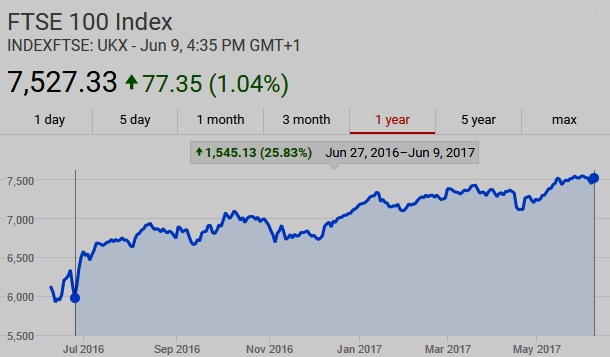
UPDATE June 9: Conservatives lost 12 seats but remain the largest party, with Labour gaining 29 seats, and both parties winning seats from the Scottish National Party (SNP) which lost 21 seats. PM Theresa May to form a new government with the DUP, according to Sky News | sky.com:

The London Stock Exchange benchmark index FTSE100 closed UP Friday, June 9:
 FTSE100

The UK election explained

Video above published May 24, 2017: Prime Minister Theresa May has brought forward the UK's next general election. The FT.com's Henry Mance explains why and how the country votes for its government.

Brexit Deadline:


feedback & comments via twitter @DomainMondo


DISCLAIMER

2017-05-26

Brexit, City of London, and the Euro Trade (video)

London and the Euro Trade

Video above published May 16, 2017: London's euro clearing dominance has been in the spotlight since the Brexit vote, as Europe would like this returned. The FT.com's Philip Stafford and Daniel Hodson, chairman of FSNForum (domain: fsnf.uk) and Board Member of Vote Leave, discuss the merits of such a move. Slides below:


See  also: New City of London group to help government with Brexit talks | Reuters.com
Financial Services Negotiation Forum (FSNForum)

feedback & comments via twitter @DomainMondo


DISCLAIMER

2017-05-12

President Trump Fires FBI Director Comey, Markets Rally, Media Shocked!

Photo of the Charging Bull in New York City's Financial District by Sam valadi (CC BY 2.0)
UPDATE  May 15, 2017:  Trump's Bulls Charge, Bears Trapped!  The S&P 500 and the Nasdaq both closed at records Monday and the Dow industrials snapped a four-session losing streak to finish higher, the TRUMP Rally continues:
 NASDAQ Hits New All-Time High
https://www.google.com/search?q=DJIA
 SP500

Original post:
S&P 500 (5 day chart as of May 10, 2017)
Opinion and Analysis

Let’s look at the way US equity markets responded on Wednesday [May 10] to the Tuesday [May 9] news of President Trump firing FBI Director James Comey:
On Wednesday, the next day, the S&P 500 rallied 0.11% (see above chart), the NASDAQ was up 0.14%, and the CBOE VIX Index barely moved back over 10, to close at 10.2. In the words of one seasoned Wall Street analyst: "If you hadn’t read the headlines for 24 hours, you wouldn’t have known anything unusual had happened in Washington or anywhere else."
Conclusion: The media's 'Trump Derangement Syndrome'  so prevalent within the reality distortion field known as "Washington, D.C.," hasn't infected Wall Street (nor Main Street). Most Americans, thankfully, are immune and are either ignoring or laughing at the mainstream media circus which has now reached unprecedented proportions.

Bottomline: Comey should have been fired by Obama last year after the stunt Comey pulled in connection with the Clinton email investigation. The last thing the U.S. needs is another rogue FBI director like J. Edgar Hoover. Trump did the right thing in following the advice and recommendation (pdf) of the Deputy Attorney General and the Attorney General of the United States, respectively.

To the disbelief and dismay of the liberal media, the Dems and elitists, Trump owns this market and the Trump Bull Rally is still running on Wall Street:
Trump Rally(chart)
The TRUMP Rally
photo of President Donald J. Trump (source: WhiteHouse.gov)
Photo courtesy of WhiteHouse.gov
feedback & comments via twitter @DomainMondo


DISCLAIMER

2017-05-10

Citadel CEO Ken Griffin on Hedge Funds, Competition, Transparency

Citadel CEO Ken Griffin on Hedge Funds, Financial Regulation

Video above published May 1, 2017: Ken Griffin, Citadel's chief executive officer, discusses the state of the hedge fund industry, competition, transparency and financial regulation with Bloomberg's Erik Schatzker at the Milken Institute Global Conference.
"... [H]arder to create Alpha today, more competition … markets more efficient (news, data, information reflected almost immediately in market pricing) which reduces Alpha available … what works? … having deep expertise in the area(s) you are investing … deep specialization drives returns … transparency creates confidence that one has been treated fairly, transparency is the underpinning of a healthy capital market … in a market that is opaque, incumbents enjoy the information advantage of that opacity but that doesn’t make a good market …”--Ken Griffin
Domains: Citadel.com and CitadelSecurities.com


feedback & comments via twitter @DomainMondo


DISCLAIMER

Domain Mondo archive