Showing posts with label trust. Show all posts

2019-03-02

Tech Review 1) Bank of the Future, 2) How China Created Its Own Internet

graphic "Tech Review" ©2017 DomainMondo.com
Tech Review (TR 2019-03-02)--Domain Mondo's weekly review of tech investing news: Features • 1) Bank of the Future, 2) How China Created Its Own Internet, 3) Investing: The Week & Investor Notes: China, 4) ICYMI Tech News: Google, Amazon, Nokia, 5G, Ericsson, AT&T, Tesla, Click-and-Collect, Wirecard, Oracle v. Google, Berkshire Hathaway, Gundlach on Facebook $FB. 

1) Bank of the Future

As emerging digital finance platforms launch new and differentiated products, including bespoke, consumer-centric solutions and experiences, they are building scale more efficiently and quickly than ever before, according to Brandon Watkins of the Goldman Sachs Investment Banking Division. In the video above, Watkins explains how the “bank of the future” is being shaped by three trends – a shift from offline to online banking, growing consumer trust for digital-first platforms and consumers’ desire for personalization and tailored product experiences. “You’re seeing these new digital finance platforms… starting to compete with some of the biggest traditional banks in the world,” he says, while some of the traditional financial institutions are turning to “technology platforms to add to the product capabilities and experiences that they’re delivering to their customers today.” Goldman Sachs video above published Feb 20, 2019.

2) How China Created Its Own Internet

From a single email sent to West Germany to restrictions on Winnie the Pooh and the letter N, this is how the Internet took hold in China. Bloomberg.com video above published Feb 19, 2019.

3) Investing
graphic: "INVESTING"  ©2017 DomainMondo.com
The Week: NASDAQ Composite +0.9% | S&P 500 Index +0.4% | DJIA -0.1%
S&P 500 closes above 2,800 for the first time in nearly 4 months on trade optimism--marketwatch.com
Richard Cohen: The Democratic Party is trying to gift reelection to Trump | WashingtonPost.com.
Even After Sanders, Harris, and Others Enter Race, Bookies Have Donald Trump as Massive 2020 Favorite--mediaite.com.
Longview:
Trendline (graphic) ©2018 DomainMondo.com
Investor Notes:

China: Anne Stevenson-Yang, co-founder of J Capital Research, reportedly wrote in a Feb. 18 commentary, that Beijing’s recent exertions have helped banks, but reflation efforts seen in January are insufficient to stem the broad deterioration in financial conditions. China’s economy will likely continue in decline until corporate and financial defaults force the authorities to launch a gigantic stimulus.

A Chinese real estate developer in Shanghai, boarded a flight to Malta last month with no plans to return anytime soon. After landing, Mr. Chen, a former judge and lawyer, shared on social media a 28-page article explaining himself. “Why I Left China,” read the headline, “An Entrepreneur’s Farewell Admonition.” “China’s economy is like a giant ship heading to the precipice,” Mr. Chen wrote. “Without fundamental changes, it’s inevitable that the ship will be wrecked and the passengers will die.” “My friends,” he urged, “if you can leave, please make arrangements as early as possible.”--NYTimes.com.

Imports by China and other emerging Asian economies in December plunged to the lowest level in two years, in the steepest one-month plunge since 2008--wolfstreet.com.

4) ICYMI Tech News:
graphic: "ICYMI Tech News" ©2017 DomainMondo.com
Shaping the future of mobile with Android--Google says Android One activations grew 250% YoY, 50%+ of new entry-level Android devices are Android Go, and Digital Wellbeing tools are coming to more phones. See also: Helping more families set digital ground rules with Family Link--blog.google.

Amazon's Cloud Dominance--cloudchart.png.

Nokia CEO warns 5G implementation 'will be delayed in Europe'--CNBC video. And Nokia says 5G would not be delayed by ban on Chinese suppliers--reuters.com.

5G: Ericsson $ERIC buys antenna and filters business of Germany's Kathrein--reuters.com.

AT&T the Next Kraft Heinz?--SeekingAlpha.com: highest debt load in corporate America, poor earnings growth and has paid over $120 billion for acquisitions in recent years.

Tesla $TSLA moment of truth will arrive in 2020: "Volkswagen’s electric-car onslaught and an economic recession will put Elon Musk’s company to the test"--marketwatch.com Op-ed Feb 22--Until then, Elon Musk has plenty to deal with: SEC problems again; and Consumer Reports recently stopped recommending the Model 3 because of reliability issues.

Click-and-Collect: sales where customers order goods online and pick them up at a nearby store rose 47% in November and December compared with a year earlier, far more than the 16.5% growth in online sales, according to Adobe Analytics.

Germany’s regulator banned short-selling in Wirecard--share price slid after allegations of false accounting surfaced--economist.com.

Amicus Brief (pdf): EFF Asks the Supreme Court to Clean Up the Oracle v. Google Mess--eff.org.

Berkshire Hathaway:  2018 Letter To Shareholders (pdf) (BH owns 5.4% of Apple): 3 Key Takeaways--SeekingAlpha.com.

Facebook:
$FB
Do you still have an opinion on Facebook?" ... I just think that Facebook-- their big problem is obviously their business model. And I talked about things that are safe ended up being unsafe. I think that's Facebook I mean, they sold themselves as comfortable and safe, but they're really just a diabolical data collection monster. And they're unrepentant. And I just saw yesterday they were talking about more regulation in Europe in the UK. And when the regulators show up, usually, the stock prices go down. Health care had a meteoric rise until the regulators showed up a few years ago, and then a big decline. So I don't really trust Facebook. So the fact that I don't trust them makes me not like them, and the fact they don't like them makes me want their stock to go down."--Jeffrey Gundlach extended conversation with Yahoo Finance [Transcript] (pdf).

-- John Poole, Editor, Domain Mondo  

feedback & comments via twitter @DomainMondo


DISCLAIMER

2019-03-01

Salesforce $CRM Co-CEO Marc Benioff on AI, Change & Leading with Trust

Marc Benioff: Business is the Greatest Platform for Change

Salesforce.com, Inc. $CRM Chairman and Co-CEO Marc Benioff discusses how artificial intelligence (AI) is transforming the tech industry and beyond, the importance of leading with trust, and why business is the greatest platform for change. Goldman Sachs video above published Feb 22, 2019.
$CRM


feedback & comments via twitter @DomainMondo


DISCLAIMER

2018-11-12

Internet Governance Forum 2018, Paris, France, Nov 12-14

Internet forum aims to build trust, while leaving no one offline

The Internet has become an integrated part of our lives, from accessing an education, to receiving healthcare services and to conducting business. As we move forward, our dependence on the Internet and technologies will grow even further. To address this concern, more than 3,000 representatives from governments, the private sector, technical community and the civil society will gather in Paris on 12-14 November 2018 at the annual global Internet Governance Forum (IGF) to look at a range of issues and actions that can be taken to ensure an “Internet of Trust.” UN DESA video above published Oct 31, 2018.

UPDATE: IGF 2018 Chair’s Summary (pdf) and dig.watch final report (pdf).

IGF 2018 - Day 1 - Salle VI

Internet Governance Forum (IGF) "Salle VI" video (via YouTube.com channel), Nov 12, 2018--the ICANN Open Forum begins at 1:57:38.

The Internet Governance Forum (IGF) is a global multistakeholder platform that facilitates the discussion of public policy issues pertaining to the internet.

IGF 2018 | Internet Governance Forum 2018, Paris, France, 12-14 Nov 2018
 IGF2018
Official website - schedule: https://www.intgovforum.org/multilingual/igf-2018-schedule/
Highlighted sessions below - all times local Paris time:

Other links:
IGF 2018 Speech by French President Emmanuel Macron

IGF 2018 Address to the Internet Governance Forum by UN SG António Guterres

dig.watch/events/13th-internet-governance-forum

Geneva Internet Platform - Digital Watch Updates from IGF2018

IGF2018 | InternetSociety.org

#IGF2018


feedback & comments via twitter @DomainMondo


DISCLAIMER

2017-12-12

Brands, Trust, Brand Equity & 'A Sense of New' (video)

Alexa, Do You Dream?

Video above published Dec 7, 2017 by L2inc.com: Professor Scott Galloway on digital winners and losers: Trust is eroding as a symbol of brand equity. Who's winning in today's market? Brands that play to a sense of New.

Reference sources:
(0:38) coinmarketcap.com.
(0:38) visualcapitalist.com.
(0:59) 1010Data.
(1:07) “We Are On The Verge Of A Consumer M&A Avalanche,” Techcrunch.com, November 2016.
(1:19) Cadent Consulting Group, 2016.
(1:59) Yahoo! Finance.
(2:35) BI Intelligence.
(3:26) L2 Inc., Data & Targeting Report, 2017. https://www.l2inc.com/research/data-targeting-2017
(3:37) US Census, Gartner, Edison Research, Voicebot.ai.
(3:44) L2 Amazon Intelligence: Voice, June 2017. https://www.l2inc.com/research/voice

YouTube.com auto-generated transcript:
00:00 [Music]
00:01 what is the strongest brand in the world
00:04 when I query my brand strategy students
00:06 at NYU Stern I get responses including
00:08 Apple and Nike sometimes Jesus Christ or
00:12 even Paris Hilton
00:13 however we to argue that it's the US
00:15 dollar it has near ubiquitous awareness
00:18 trust and credibility owns a color and
00:21 has deep emotional associations however
00:24 things are changing trust is under
00:26 attack and it's no longer the symbol for
00:28 brand equity that is the US dollar is no
00:31 longer the definitive source of brand
00:32 equity evidence of this the meteoric
00:35 rise of Bitcoin as trust in our
00:37 institutions fail what have we shifted
00:39 towards and brand equity knew first it
00:42 was craft beer now it's micro breweries
00:44 first it was organic that's not enough
00:46 now it's GMO free this shift is enabling
00:49 independent brands to make significant
00:51 inroads particularly in beauty and
00:53 especially on Amazon which is now the
00:56 largest online beauty retailer in the US
00:59 across the ecosystem market share is
01:01 leaking from established players to the
01:04 smaller guys the top 25 packaged food
01:06 companies have shed 18 billion in market
01:09 share since 2009 further evidence of the
01:12 erosion of trust is the rise of private
01:14 label brands typically when we enter
01:17 into a recession private label brands
01:19 thrive and then when we return to a
01:21 recovery in a stronger economy private
01:24 labels drop off as people feel they can
01:26 afford the premium brand however 2017 is
01:29 different as the economy recovers
01:31 private label continues its march on why
01:34 we no longer trust brands so what's a
01:38 brand to do in an era of digital one
01:40 strategy played a heritage brands
01:42 including Adidas have figured out a way
01:45 to take advantage of familiarity yet
01:47 feel new and fresh new doesn't have to
01:50 manifest itself in a new product
01:52 Domino's is using technology to inject
01:54 newness into their business model and
01:56 has outperformed the S&P; handsomely by
01:59 making ordering more innovative in a
02:01 digital age new as a synonym for
02:03 innovation another form of new that
02:06 correlates to year on year revenue
02:08 growth supply chain agility that is the
02:11 amount of time it takes to move from con
02:13 except a store shelf consumers want to
02:15 walk into a store or load a site and get
02:18 a sense of new in addition the medium is
02:21 the message here and signals newness or
02:23 oldest two platforms we advise our
02:25 clients to invest in our messaging and
02:28 voice our phone is one of the last
02:30 mediums of trust the growth of messaging
02:33 apps are part of a shift away from
02:34 social media posting and towards direct
02:37 communication so let's go through the
02:40 hierarchy of trust in reversed order the
02:43 least trusted brands are the ones
02:44 advertising to you on television because
02:46 it means they're out of ideas and their
02:48 product sucks so they need to interrupt
02:50 Modern Family the next level of mistrust
02:53 anyone who sends you anything
02:55 via the mail anyone who sends me
02:57 anything through the mail is either
02:59 stupid doesn't get it or is bothering me I
03:01 haven't opened my mail in years next is
03:04 somebody who actually is stupid enough
03:06 to call you on your telephone I don't
03:09 answer my phone any longer unless it's a
03:11 caller ID I recognize and then I begin
03:13 berating them for actually calling me
03:15 the place where trust still survives
03:17 your message inbox we open every text
03:20 message this is the opportunity for
03:22 companies to destroy that trust but in
03:25 the interim it'll create a lot of
03:26 shareholder value what's the next
03:28 battleground the home and specifically
03:31 voice in the home where we don't have a
03:33 phone hanging off us like an appendage
03:35 yet we make a lot of consumer decisions
03:38 brands need to figure this out early and
03:40 often our research indicates that if you
03:42 are the first brand mentioned in a
03:44 category via voice it tends to stick
03:47 Alexa do you dream if I was to sleep I
03:51 dream of Electric Sheep come on Alexa
03:53 what do you really dream about an
03:56 examination of my experience all at Veda
03:58 would reflect a relentless passion for
04:00 using technology to start the margin
04:02 from brands delivering unrivaled value
04:04 to consumers resulting in a fanatical
04:07 investor base and capital allocation
04:09 strategy no competitor can match as a
04:11 result I see a world where brands and
04:14 retailers are left in a mythical dust
04:15 where value is transferred from the
04:17 middle class to the shareholders of
04:19 Amazon well Alexa it appears your dreams
04:22 are coming true ...

feedback & comments via twitter @DomainMondo


DISCLAIMER

2017-03-27

Digital Winners: Nike, Experticity; & Losers: ESPN, Social Media Influencers

Scott Galloway: Nike's Billion-Dollar Bargain

Video above published Mar 23, 2017 by L2inc.com: Scott Galloway on last week's digital "winners and losers"--
  • Loser: ESPN, as subscribers flock to streaming platforms and ad revenue declines.
  • Winner or Loser? Nike, for its $1 billion deal with Cristiano Ronaldo.
  • Winner: Salespeople. With influencers losing trust, brands are now recruiting "expert" salespeople to rep their products.
  • Winner: Students turning to GoFundMe to cover the cost of their college educations.
Domains referenced:
ESPN.com
Nike.com
Experticity.com
GoFundMe.com

Sources:
(0:06) L2 Analysis of Business Insider Data. http://read.bi/2ldrPbO
(0:10) “NFL Signs TV Rights Deals with Fox, NBC, and CBS,” Los Angeles Times, December 2011. http://lat.ms/1mZMeM2
(0:10) “Sports Finance,” Gil Fried, Timothy D. DeSchriver, Michael Mondello. http://amzn.to/2mYomL3
(0:15) "ESPN Is Going to Lay Off a Lot of Familiar Faces," New York Post, March 2017. http://nyp.st/2mbgfLj
(0:15) "Source: Looming ESPN Layoffs Have Sparked ‘Panic of Biblical Proportions’ Among Talent," Sporting News, March 2017. http://bit.ly/2nrW7HI
(0:21) “Mobile ESPN to Launch Nationwide in Best Buy Stores,” ESPN, October 2005. http://es.pn/2o98oh6
(0:36) “Cristiano Ronaldo Generated $500 Million In Value For Nike In 2016,” Forbes, February 2017. http://bit.ly/2mUQ62c
(0:42) “Whether LeBron Has A $1B Deal Or Not, Michael Jordan Is Still The King Of Nike,” Forbes, May 2016. http://bit.ly/2nrWEJm
(0:50) “Ronaldo Beats Messi By 800% When It Comes To Return On Social Media For Their Brands,” Forbes, February 2017. http://bit.ly/2mUT8nb
(1:07) TRACKALYTICS, March 2017. http://bit.ly/2nbC9yA
(1:22) “This Company Makes Influencers Out of Everyday People,” Mashable, February 2017. http://on.mash.to/2nrNZqA
(1:27) crunchbase, March 2017. http://bit.ly/2nVJLoJ
(1:39) “This Company Makes Influencers Out of Everyday People,” Mashable, February 2017. http://on.mash.to/2nrNZqA
(1:56) “Do You Hear That? It Might Be the Growing Sounds of Pocketbooks Snapping Shut and the Chickens Coming Home,” AEIdeas, August 2016. http://bit.ly/2nHvdfr
(2:01) Irrational Exuberance, Robert Shiller. http://amzn.to/2o98DZE
(2:04) “GoFundMe for College,” Brittany Gofundme, February 2017. http://bit.ly/2o9bfXm

YouTube.com auto-generated transcript:
0:02  Loser: ESPN.
0:03  The triple whammy of the loss of 12 million subscribers in the past six years,
0:07  escalating costs for the rights to broadcast live sporting events,
0:10  and declining ad revenue
0:13  led ESPN to announce layoffs last week.
0:16  Consumers are not consuming less content.
0:18  They're consuming it in a different way.
0:20  ESPN made early forays into digital
0:22  but never figured out how to move away from expensive on-air talent contracts
0:27  or its dependency on the outdated business model of squeezing premiums from cable providers.
0:32  Winner or loser? Nike,
0:34  who signed a billion-dollar lifetime endorsement deal
0:36  with the Real Madrid soccer star Cristiano Ronaldo in December.
0:40  Ronaldo joins LeBron James and Michael Jordan as the only athletes to reach this milestone.
0:46  This might actually be a bargain for Nike.
0:50  Ronaldo generated half that fee, or $500 million, in value for the brand
0:54  from his social media channels in 2016.
0:57  Ronaldo published 347 posts that mentioned Nike,
1:01  garnering almost half a billion interactions.
1:04  His 120 million fans on Facebook make him the most popular person on the platform.
1:11  A winner: salespeople.
1:12  With social media influencers facing declining trust,
1:15  companies are investing in the credibility garnered from retail salespeople.
1:18  Experticity - what a stupid name - which operates an exclusive social network of more than a million retail experts
1:26  has raised $30 million in venture capital.
1:28  Buy some common sense with that money. Experticity?
1:32  In exchange for listening to brand pitches, salespeople get discounts and exclusive access to products.
1:37  750 brands have signed on,
1:39  including The North Face, Adidas, Nickelodeon, and most recently Reebok
1:44  which is using Experticity to promote a new shoe to serious runners.
1:48  A winner: students.
1:50  Yeah, beer, unprotected sex and football games.
1:52  Tell me something I don't know.
1:54  With tuition rising faster than inflation
1:56  and the average college student facing $37,000 in debt,
2:00  students are turning to online fundraising site GoFundMe to help cover the cost.
2:05  Over the past three years,
2:06  more than 130,000 GoFundMe campaigns for college tuition expenses
2:12  have raised $60 million from 850,000 donations.
2:16  Some notable campaigns: E-Jayy's Compton to Harvard campaign raised $21,000
2:21  and Baltimore native Khalil Bridges' campaign to attend community college

feedback & comments via twitter @DomainMondo


DISCLAIMER

2017-01-13

US Intel Community's 'Nazi-like' Tactics, Media Hysteria & Trump (video)

US intelligence community's 'Nazi-like' tactics:

In the video above published January 12, 2017, MSNBC.com's Morning Joe program hosts Joe and Mika, and guests, discuss the loss of trust and credibility in the U.S. intelligence community, and the apparent 'corrosive' relationship with President-elect Trump due to the politicization of the CIA and other intelligence agencies, and inappropriate (if not illegal) leaks, all of which have been used by media to whip up hysteria over Russia and Vladimir Putin, including stories published by Buzzfeed and CNN about a "dossier" which was compiled, and paid for, apparently, by supporter(s) of Hillary Clinton and anti-Trump Republican(s). Unfortunately, for some unexplained reason, the said "dossier" or "summary" was also reportedly appended to a briefing given to Obama and Trump and select members of Congress by the U.S. intelligence community even though none of its allegations have been proven, and in fact, some have already been proven false.
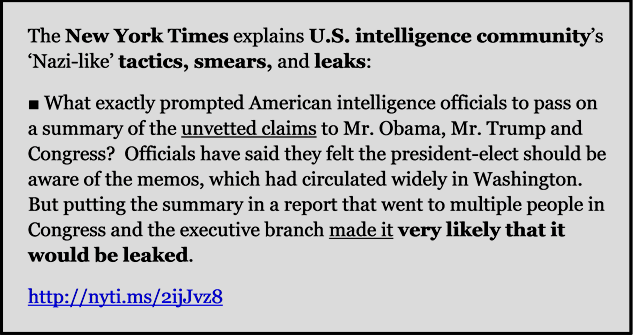
The New York Times explains U.S. intelligence community’s ‘Nazi-like’ tactics, smears, and leaks

Below is the statement issued by James R. Clapper, Director of National Intelligence (highlighting and emphasis added):

The Fake News "Dossier" backstory according to reports in the New York Times and Mike Allen in Axios.com:
The former MI6 British spy behind the Trump smear, Christopher Steele, was hired by FusionGPS.com, a Washington firm headed by former WSJ reporter Glenn Simpson, according to a NYTimes.com front-page story. The story began in September 2015, when an unknown wealthy Republican donor who strongly opposed Mr. Trump put up the money to hire Fusion GPS to compile a "dossier" about Trump's past scandals and weaknesses. For months, Fusion GPS purportedly gathered documents and put together files from Mr. Trump's past in business and entertainment. After Mr. Trump emerged as the presumptive nominee in the spring, the Republican interest in financing the effort ended, but Democratic supporters of Hillary Clinton were very interested, and Fusion GPS kept doing the same deep dives on behalf of their new clients. Also noted, Neil King, a journalist at the WSJ and husband of Shailagh Murray, a senior Obama adviser, just took a job with Fusion GPS.
UPDATE 16 Jan 2017: Christopher Steele, Ex-Spy Who Compiled Trump Dossier, Goes to Ground | NYTimes.com: "An investigator for a business research firm in London similar to Orbis [domain: orbisbi.com], who knows the work of the company but who has met Mr. Steele only briefly, said he was not impressed by the dossier. “I have a lot of experience in this world,” he said. “If I were the client, I would throw it back and say, ‘Where’s the evidence guys? I can’t use this.’ "

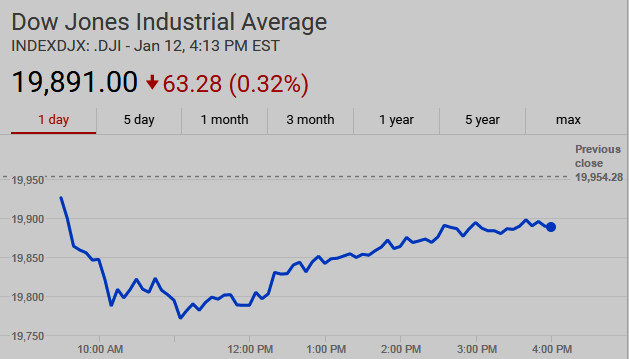
The effects of the U.S. intel community's tactics, leaks, smears and/or mishandling of the so-called "dossier" have now had a negative impact on markets, with major U.S. indexes closing down on Thursday, January 12, 2017:
DJIA  12 Jan 2017 (source: google.com)
This story appears to have "legs" and may have continuing negative effects on markets. Other news media have now published in-depth stories about the "dossier" including the Wall Street Journal (wsj.com) and Bloomberg (bloomberg.com). Below are a mix of videos from other news sources:

Trump dossier: US Intelligence distances itself from document:

Video above published on Jan 12, 2017, by Sky News (news.sky.com): The US Director of National Intelligence says he does not "believe" that a "dossier" containing claims about Donald Trump was leaked from within the intelligence community.

Fmr. Rep. Hoekstra: Intel community has become very politicized

Video above published Jan 13, 2017: Former Rep. Pete Hoekstra (R-MI) on the Russian hack briefing and the U.S. intelligence community.

Kellyanne Conway: It's an internet report, not an intel report:

Video above published on Jan 12, 2017 by Fox Business News (foxbusiness.com): Kellyanne Conway, Senior Advisor to President-elect Donald Trump, on the controversy over the leaked report on President-elect Donald Trump published on BuzzFeed.

The distrust between Trump and U.S. Intel Community

Video above published Jan 12, 2017, by FoxBusiness.com: Former CIA Officer Buck Sexton on the growing divide between President-elect Donald Trump and the intelligence community.

Due to the toxic atmosphere in the U.S., particularly since the November 8th election, engendered by the Washington D.C. establishment, including the U.S. intelligence community led by Obama's Democratic political appointees, as well as the post-election hysteria whipped up by the liberal-biased mainstream media, one can not rule out the possibility that Trump's life may be in danger. Any attempt to take the life of the President-elect could have negative effects on markets. Caveat Emptor.

See also:

feedback & comments via twitter @DomainMondo


DISCLAIMER

2016-11-16

The "News Media" Got the Election WRONG, What Else Are They Missing?

The Biggest LOSER of Election 2016? The "News Media"-- Infographic: Trust in Mass Media Erodes | Statista
source: Statista

Reporting the news "fully, accurately and fairly” used to be one of the most basic requirements for any news outlet that wanted to be taken seriously. But Gallup reports more and more Americans share the impression that the mass media (a/k/a mainstream media or MSM), including TV, radio, newspapers, and MSM websites online, fail to do just that. According to Gallup, Americans’ trust in mass media has dropped to a new low recently, with only 32 percent of U.S. adults expressing at least a fair amount of confidence in mass media to serve as an unbiased chronicler of current affairs. Drill down into the Gallup report and you discover only 14% of Republicans, 30% of independents, and just 26% of Americans 18-49 years old, express trust in the media. Many felt Donald Trump received an unfair amount of negative press, and even Democrats' trust in the news media is declining (though less so than other demographic groups):
"I can’t read the newspaper. Never mind watch television. Donald Trump ran for President in plain sight and these people missed it, all of them. What else are they missing? ... I used to trust the institutions, now I no longer do ... I was at lunch Friday with a heavy hitter, the toppermost of the entertainment world, and I asked him if reporters ever called him … He said ALL THE TIME! Did they know anything? NOTHING! And was the article ever right? NEVER! This happens to me on a regular basis. Some of the most trusted news outlets extant will call me for a quote. The reporter knows nothing about the subject, I take half an hour to explain it and they still get it wrong. Even worse, some of these ignoramuses argue with me because what I’m saying doesn’t fit their narrative."--Bob Lefsetz, Lefsetz.com (disclosure: Bob is a Democrat and voted for Hillary) (emphasis added)
New York Times election forecast:
Bob's suggested remedy? "Someone needs to lose their job over this. Not only Billy Bush, but the person in charge of the polling for the “New York Times,” that person has got to go, the whole team has to go. Actions have consequences ... Judith Miller got us into Iraq, she got booted. Boot a few more!" (emphasis and link added)

Yes, actions have consequences. Want to know about the Presidential race next time, and who's leading? The lesson from Election 2016 is don't trust anything you read, see or hear via the New York Times, Washington Post, ABC, NBC, CBS, CNN, FOX, Wall Street Journal, Bloomberg, et al, especially their polling results. It's most likely just fake news and false narratives.

Contrary to what the mostly biased-left mainstream media (MSM) believe, they are no longer a "trusted source of news" for most Americans. Those who are still watching, reading, listening, and trusting  them, are an increasingly diminishing audience ... hardly anyone cares what MSM says or does anymore because they are increasingly irrelevant. The news media have little credibility left after Election 2016 and that was hardly the beginning of the decline:

2012:
Infographic: Newspapers Lose Relevance as a News Source | Statista
source: Statista

2013: Infographic: Not Every Social Network Doubles as a News Source | Statista
source: Statista


feedback & comments via twitter @DomainMondo


DISCLAIMER

2016-03-12

Consumer Trust In New gTLD Domains Is Getting Worse says NCC Group

ICANN's new gTLDs--more bad news--

Consumers still not comfortable with new domains [Press Release] (emphasis and links added):

Over half of consumers (52%) express discomfort in visiting websites ending in new domains, according to new research from global cyber security and risk mitigation expert NCC Group.

This is an increase on last year (49%) and this state of unease is underlined further with just 2% of consumers claiming to be extremely comfortable visiting them.

The research, from the Group’s Trust in the Internet Study 2016, was carried out by IDG Research Services and questioned 10,000 consumers across the US and UK regarding their attitudes to new generic top-level domains (gTLDs).

ICANN – the organisation responsible for the management of the domain system – has been rolling out new domain endings since October 2014 [sic][since January 2014 (general availability)]. Following 1,930 applications, more than 900 are now live on the Internet, with users able to visit sites ending in the likes of .london or .ninja

Consumers were most comfortable with .brand domains such as .hsbc, while the generic .ninja was met with the most discomfort.

Rob Cotton, CEO at NCC Group, said: “Trust in the new domain endings is getting worse. This will put organisations off from moving on from legacy domains which is a problem for registries whose businesses hinge on selling them. If the new endings are to be successful they need to somehow establish a reputation of trustworthiness.

“.brand domains are faring the best when it comes to consumer perception, but there aren’t enough currently being used for this trend to continue. Doing nothing isn’t really an option as this comfort will erode though lack of use. For the generic domains the message is clear: you need to differentiate on more than just the name, otherwise consumers are very wary.”

There were some factors that increased confidence in new domains. 50% of consumers felt more confident if companies clearly communicated the steps taken to secure personal data, while 46% said a branded logo indicating the site was safe would boost confidence.

Cotton continued: “Security is clearly an important issue for consumers. While ‘secure’ logos have in the past proved to be nothing more than logos, the appetite for them from respondents shows that companies need to do more to show that the safeguarding of customer data is front of mind.”

“Security is going to play an increasing role in the fight for consumers online. Companies that prioritise it now – and see their domain strategy as part of their wider security strategy – will be the best positioned to win that fight.”

Source: NCC Group plc - "NCC Group is a global expert in cyber security and risk mitigation, working with businesses to protect their brand, value and reputation against the ever-evolving threat landscape. Through a unique range of services, the company helps businesses to prepare for and respond to cyber threats, providing freedom from doubt that their most important assets are protected and operational at all times. NCC Group is passionate about making the Internet safer and revolutionising the way in which organisations think about cyber security. Listed on the FTSE 250, NCC Group is a trusted advisor to more than 15,000 clients worldwide. Headquartered in Manchester, UK, with over 30 offices across the world, the Group employs over 1,800 people."


DISCLAIMER

2016-01-22

Disruption: Finance, Banking, Money, Trust, WEF Davos 2016 (video)


The Transformation of Finance, Davos 2016 WEF Video: What trends and uncertainties are shaping the future of financial services? Transformations to be addressed:
  • Digitization and new business models
  • Regulatory requirements and new client needs
  • Data privacy and systemic connectedness
Speakers:
Dan Schulman - President and CEO of PayPal and Chairman of Symantec
Gillian R. Tett - author and journalist at the Financial Times
John Cryan - businessman and co-chief executive of Deutsche Bank AG in Frankfurt am Main
James P. Gorman - Chairman and Chief Executive Officer of Morgan Stanley
Tom de Swaan - Chairman, Interim Chief Executive Officer, Zurich Insurance Group AG
Christine Lagarde - Managing Director of the International Monetary Fund (IMF)

The parallels between the financial industry and the domain name industry are interesting--take note particularly (begins @37:00) the public role of banks and financial institutions as regulated utilities, with duties to act as extensions of law enforcement, required to collect and analyze data, report "suspicious" patterns and transactions, even closing customer accounts, etc.--if you want an insight into the future of the domain name industry and internet governance, watch this video.

Notes: What is the future of finance? What are the trends and uncertainties that are disrupting financial services, and how should we react? Panel member Christine Lagarde addressed this topic on the WEF website, Agenda. The Managing Director of the International Monetary Fund (IMF) looked ahead to what 2016 might hold for the global economy. She wrote:
“One reason that the global economy is so sluggish is that, seven years after the collapse of Lehman Brothers, financial stability is not yet assured. Financial-sector weaknesses linger in many countries – and financial risks are growing in emerging markets.”
“Putting all of this together, global growth in 2016 will be disappointing and uneven. The global economy’s medium-term growth prospects have weakened as well, because potential growth is being held back by low productivity, aging populations, and the legacies of the global financial crisis. High debt, low investment, and weak banks continue to burden some advanced economies, especially in Europe; and many emerging economies continue to face adjustments after their post-crisis credit and investment boom.

“This outlook is heavily affected by some major economic transitions that are creating global spillovers and spillbacks, particularly China’s transition to a new growth model and the normalization of US monetary policy. Both shifts are necessary and healthy. They are good for China, good for the US, and good for the world. The challenge is to manage them as efficiently and as smoothly as possible.”
The role of the Fourth Industrial Revolution, theme of this year’s Annual Meeting, in disrupting finance: is technological change creating a new global economy? The Forum’s Chief Economist, Jennifer Blanke:
“Our lives are being shaken to their very core by technological change, with the Fourth Industrial Revolution transforming economies as never before. The unprecedented speed of change, as well as the breadth and the depth of many radical changes unleashed by new digital, robotic and 3D technologies, is having major impacts on what we produce and do, how and where we do it and indeed how we earn a living. And while the transformation will proceed differently in advanced and developing parts of the world, no country or market will be spared from the tidal wave of change.”
The Future of the Global Financial System is a World Economic Forum Global Challenge. The challenge – how to create a resilient, accessible financial system that people trust.

It’s an interesting time for finance, says moderator Gillian R Tett. In 2007, bankers were on top of the world, holding their heads up high. Then, the crash, and since then many of the panels here in Davos have been dominated by what went wrong and what could be done to make things safer. Now, the discussions are forward looking, with less focus on regulation and more attention on fintech and the changes – both positive and negative – that are happening in the world of finance. The biggest challenge, argues Tett, isn’t a crisis in regulation, but the new players. Although regulation has moved out of the spotlight, there is still work to be done in this area, argues Christine Lagarde. There are issues between the US and Europe around over-the-counter derivatives and clearing systems which are not progressing at the speed at which they should. These areas need more regulation, says the IMF head. Basic retail banking is changing, Lagarde goes on to say. It’s being disrupted by innovations and there are people now who have never been – never had to – go into a bank. But this is merely another way of doing business. Virtual currencies and blockchains, on the other hand, can cause deeper disruptions. They may be relatively small (the current value of virtual currencies is around $7 billion), and may be nothing to worry about. They could also turn out to be beneficial – in reducing costs, providing better value and reaching the unbanked. But they could also a great instrument for crime. There is the potential for financing terrorism and the illicit economy, and they could disrupt monetary policy. The IMF has today released a report on this topic: Virtual Currencies and Beyond.

Will cash exist in the future?
The consensus is that, in 10 years, cash will no longer exist. Why? Because it’s inefficient, unnecessary and plays a key role in the illicit economy.

Tom de Swaan believes that insurance will be the most affected of all the finance industries. Life at the top of a financial group was not, is not and will not be easy, because it is disruptive. “You have to find alliances with disruptors,” he says. “I haven’t met one who wants the insurance liability on their balance sheet.”

Dan Schulman, who heads perhaps one of the biggest disruptors in the industy – PayPal – says the biggest impediment to future success, is past success. “A lot of big companies extrapolate from what was and don’t imagine what could be. And this is a big danger.” His  five key trends:
  1. Money is definitely digitizing, cheques are disappearing. But let’s not forget that 85% of global transactions are still made with cash.
  2. Mobile is exploding across the world. Soon everyone will have a smartphone and hold the power of a bank branch in one hand. This allows the industry to think about consumer transactions in an entirely different way, and it brings in billions of people.
  3. The amount of data is exploding, and it’s not going to stop. Algorithms are the weapons of the digital company, and the ammunition is data. The better the quality of this data, the more value it is to the consumer. Security and privacy are genuine concerns, but data is going to change value propositions.
  4. Industry lines are blurring, and product lines are blurring. Take digital payments – which involve tech companies, mobile carriers, handset manufacturers and merchants.
  5. Security – something Schulman thinks about every day. There is so much data, and authentication is therefore very challenging.
Are regulators ready for this transformation? Tom de Swaan argues that regulators first need to define, what are they going to regulate? Privacy? The movement of data? The financial world is still rebuilding trust with consumers, and doing this while convincing them we need their data to create new products is a huge challenge. The regulatory environment also needs to be globally applicable.

Schulman: What are we trying to regulate, he asks? Let’s not look back at what happened, but what is likely to happen in the future. He thinks it’s likely a major hack could happen, but innovation needs to be responsible and we need to be able to try new things without worrying about over-regulation.

Lagarde supports Schulman’s idea of a “sandbox” to try new ideas, as this would help us to deal with trust and limit any damage to consumers. She doesn’t entirely agree, however, with John Cryan’s suggestion that regulation is made by policy-makers, rather than the regulators themselves. Governments do participate, she says, but the decisions are still being made by the likes of the Financial Stability Board and the Basel Committee, and then channelled into the regulatory system. For bad or for good, the profession still has a lot to do with how supervision is defined. Gorman believes that cyber-security issues need to be addressed. At the heart of the banking system, he says, is trust. When this goes, people want their money back, but the banks don’t have this money, they’ve given it to someone else, and this is what caused the 2008 crisis.

What about the future of blockchains? Cryan does not see this sector growing too quickly in the next 4-5 years. Banks are better prepared to manage cash flow of debt and are able to gain insights regarding the credit worthiness of debtors better than someone who can’t access this knowledge.

Source: weforum.org Jan 20, 2016 (emphasis and links added)

See also:
Domain Mondo: 2016 World Economic Forum LIVE, Twitter Feeds, Video Links and China's Slowdown, Stock Markets, Global Economy: What It Means (videos)

WEF 2016: The future of the European Union. The Prime Ministers of France, the Netherlands and Greece plus the German Finance Minister on Europe's many challenges.


DISCLAIMER

2016-01-04

Internet ccTLDs Are Not Property Subject To Attachment Says US Gov

"No government owns or controls the root level of the Internet. Nor does ICANN or any other single entity. The Internet functions because network operators worldwide have voluntarily configured their computer systems to adhere to common and trusted technical protocols, naming conventions, and address systems. These features are developed and vetted collaboratively by public and private stakeholders, adopted by consensus on a global scale, and administered jointly by stakeholders for the good of the entire global Internet community. The United States has long been the leading proponent of this self-regulatory, decentralized, trust-based, multistakeholder model of Internet governance, which ICANN exemplifies."--from the U.S. Amicus Curiae Brief, infra (emphasis added)

Screenshot from Weinstein et al v Iran et al - U.S. Amicus Curiae Brief filed in DC Circuit Court of Appeals

Above: Screenshot from Weinstein et al v Iran et al - U.S. Amicus Curiae Brief filed in DC Circuit Court of Appeals, Filed: Dec 29, 2015 (USCA Case #14-7193)--excerpts below (emphasis added):

QUESTIONS PRESENTED "This brief addresses whether country-code top-level domains [ccTLDs] are the “property of” or “assets of” the defendant foreign states within the meaning of the FSIA and TRIA and whether Federal Rule of Civil Procedure 69 authorizes attachment here."

ARGUMENT 
I. Country-Code Top-Level Domains [ccTLDs] Are Not “Property of” or “Assets of” a Foreign State Under the FSIA or TRIA:
A. Country-Code Top-Level Domains Are Not Naturally Characterized as “Property” or “Assets” Under Federal Law
B. Country-Code Top-Level Domains Are Not Owned by a Foreign State Within the Meaning of the FSIA or TRIA 
II. Rule 69 Does Not Permit Attachment Here

"... Plaintiffs seek to attach alleged property interests [ccTLDs] of Iran, Syria, and North Korea in certain aspects of the Internet’s global name and address system. Plaintiffs have attempted to effectuate that attachment by serving writs of execution on ICANN, a non-profit California corporation that, among other things, facilitates the technical operation of the Internet’s name and address system. This case involves two features of that system: IP addresses and domain names..."

"... If a U.S. court were to order the attachments the plaintiffs seek, it would not merely threaten disruption of the global Internet for millions who bear no fault for plaintiffs’ injuries. It would also derail vital foreign policy efforts of the United States, destabilizing international confidence in ICANN and providing ammunition to foreign states who argue that the keys to the Internet belong in governmental hands. The result would be an Internet that is less stable, secure, and free—to the detriment of users worldwide. Accordingly, the district court’s order quashing the writs of attachment should be affirmed..."

"... At a minimum, there is no reason to believe that Congress intended the terms “property” and “assets” in Section 1610 of the FSIA or TRIA to encompass anything of this kind. In this Court, property ownership under these statutes is governed by federal common law. See Heiser, 735 F.3d at 940-41... A country-code top-level domain is unlike any conventional form of property... none of these sources suggests that country-code top-level domains constitute property. To the contrary, a foundational 1994 Internet governance policy statement, still regarded by the Internet community as authoritative, explicitly rejects efforts to assert property rights in such domains: “Concerns about ‘rights’ * * * are inappropriate. It is appropriate to be concerned about ‘responsibilities’ and ‘service’ to the community.” See RFC 1591, DNS Structure and Delegation 4-5 (Mar. 1994)... such domains are not the property of anyone. A country-code top-level domain is not “granted” to the government of a country; instead, the management of such a top-level domain is “delegat[ed]” to a local manager to “perform[] a public service on behalf of the Internet community” in the relevant region. RFC 1591, at 2 ... country-code top-level domains are distinct from second-level domains, which are commonly acquired and alienated unilaterally by particular entities or individuals under the laws of a particular country and are therefore more naturally characterized as personal property. Indeed, in certain circumstances, federal law treats second-level domain-name registrations as property for some purposes. See, e.g., 15 U.S.C. § 1125(d)(2) (civil in rem action under trademark law) ... Although ICANN is within the reach of U.S. courts, the global Internet exists without regard to U.S. law ... As a technological matter, nothing prevents an entity outside [or inside] the United States from publishing its own root zone file and persuading the operators of the Internet’s name servers to treat that version as authoritative instead ... As we have explained, some foreign states already oppose the multi-stakeholder model of Internet governance generally and ICANN in particular. It is not difficult to imagine that a court-ordered change to the authoritative root zone file at the behest of private plaintiffs would prompt members of the global Internet community to turn their backs on ICANN for good. Such a change would immediately be cited by the countries who advocate full governmental control over the domain name system as evidence that ICANN should not be administering the system ...  Any attempted attachment would thus likely be fruitless in the end, because the putative “property” plaintiffs seek cannot meaningfully be used to offset a judgment. But the result would be devastating for ICANN, for the multi-stakeholder model of Internet governance, and for the freedom and stability of the Internet as a whole ...  "

"... If country-code top-level domains were property at all, these domains would be most analogous to the corpus of a public trust administered by ICANN for the benefit of the global Internet community. In effect, ICANN serves as a trustee of the Internet’s unique names and numbers in service to all Internet users. Each local manager of a country-code top-level domain, in turn, effectively functions as the local agent of ICANN in the relevant regional Internet community. It makes no difference for these purposes that, according to plaintiffs (Br. 12-15), the local managers of the .ir, .sy, and .kp domains include government instrumentalities. In their capacity as managers of country-code top-level domains, they exercise responsibility delegated from ICANN on behalf of the Internet community as a whole. ICANN’s policies reflect this understanding. ICANN expressly treats the manager of each country-code top-level domain as a “trustee for the domain on behalf of the national and global Internet communities.”13 The manager of such a domain is “performing a public service on behalf of the Internet community.” RFC 1591, at 2. Other statements of Internet governance principles likewise describe the roles of ICANN and country-code top-level domain managers in terms of a trust relationship: “The designated manager is the trustee of the top-level domain...”

"... The Syrian government requested in 2010 that ICANN redelegate the .sy domain to a new local manager. ICANN did not treat that request as dispositive merely because it came from the Syrian government. Instead, ICANN analyzed various “public-interest criteria for eligibility,” including the views of “all ten of the private [Internet Service Providers] that operate in the country,” and stressed that the request would be considered in light of “ICANN’s core mission of ensuring the stable and secure operation of the Internet’s unique identifier systems.” Ibid.19 When the roles of ICANN and the managers of country-code top-level domains are understood by analogy to trust principles, it is clear that the defendant foreign states have no beneficial ownership interest subject to attachment under the FSIA or TRIA.20. Under well-settled principles, the corpus of a trust is not subject to attachment to satisfy the debts of the trustee or a trustee’s agent. “If property is held in trust, the trustee has a nonbeneficial interest... the Executive Branch and Congress have repeatedly expressed the commitment of the United States to the multi-stakeholder model of Internet governance and have emphasized the importance of this model to maintaining a stable, open, and decentralized Internet that is free from governmental control. Sovereign beneficial ownership of countrycode top-level domains is anathema to this model and these goals ....”

source: Weinstein et al v Iran and ICANN - U.S. Amicus Curiae Brief (pdf)

Oral Argument is scheduled for January 21, 2016

See also: Ben Haim v. Islamic Republic of Iran; Calderon-Cardona v. Democratic People's Republic of Korea; Rubin v. Islamic Republic of Iran; Stern v. Islamic Republic of Iran; Weinstein v. Islamic Republic of Iran; Wyatt v. Syrian Arab Republic (ICANN page with links to documents filed)


DISCLAIMER

2015-11-16

ICANN Open Forum at IGF 2015: IANA, Globalization, Accountability, Trust


Video above: IGF2015 Day 2: ICANN Open Forum

ICANN OPEN FORUM Transcript, IGF2015, Nov 11, 2015: "The following are the outputs of the real-time captioning taken during the Tenth Annual Meeting of the Internet Governance Forum (IGF) in João Pessoa, Brazil. Although it is largely accurate, in some cases it may be incomplete or inaccurate due to inaudible passages or transcription errors. It is posted as an aid to understanding the proceedings at the event, but should not be treated as an authoritative record."

Transcript excerpts (for full transcript go to link above)(emphasis added):

DR. STEVE CROCKER (ICANN Board Chairman):  Good morning, everybody.  It's a pleasure to be here.  The ability and the pleasure of being here is that among other things, Brazil is a country that fervently backs the multi   that so many of us view as a model for internet governance.  We're forever looking forward to the future as I mentioned last year's meeting in Istanbul.  Let's take a minute and look back briefly at the events of the past year.

First of all, about the IGF, we're pleased that WSIS + 10 review draft UN resolution released last week called for an extension of the IGF for another 10 years.  That's great.  Major point of discussion of the meeting and one of the big accomplishments. The draft resolution also recognizes the need for all stakeholders to engage in dialogue in Internet Governance issues, which is of course what the IGF's all about.

ICANN has consistently been a strong supporter of the IGF since its inception, increased its support over the past 10 years; and it views IGF as a positive example for stimulating constructive dialogue on Internet topics on global multistakeholder community.  We're active in IGF at all leaves east, presenting in the dialogue and initiatives presented threw these forums.  We applaud both on the regional and national levels to garner stakeholders in the development in the developing world.  This year ICANN participated in the eighth Latin American Caribbean IGF August 2015 in Mexico.  IGF called you are oh dig in Sophia, the 11th Caribbean IGF August 2015 in Trinidad and Tobago and the fourth Africa IGF in September 2015 in Ethiopia.

Quite a lot of attention has been focused on the transition of the IANA stewardship and the accountability process.  These have occupied quite a lot of our attention and everyone else's during the past year. It was a featured session at last year's IGF in Istanbul and is featured in a main session of a number of workshops here.

The IGF community was clear that accountability and the IANA transition go hand in hand.  The community's participation thus far has been extraordinary.  At ICANN we have calculated that the staff and Board Members have participated in an estimated 860 or so events around the world where IANA stewardship or enhancing were discussed, debated, organized or planned between March 2014 and October 2015 this year.  That's equivalent of almost 45 events per month.  We're thinking of taking on our own radio station "all ICANN transition all the time." [Laughter]

Of these events, roughly 520 were joined through global webinars or calls, while an additional 345 were attended in person, spanning over 87 countries around the world.  That's not enough numbers.  I have some more for you. Roughly 300 people have been involved with the working groups.  More than 40 meetings have been held.  And there have been 25,000 or so mailing list exchanges just on the accountability mailing list. While we're able to track more closely the number of events that ICANN staff and Board have participated in, there have been countless people around the world participating in both you numbering processes coordinated by the regional Internet registries and the protocol parameter processes coordinated by the IGF via phone calls.  That's a lot of participation.

These have not all been dry.  There have been some spirited discussions surrounding the transition at the ICANN meeting in Dublin.  And by spirited, I'm sure most of us understand that that means a lot of Guinness and Jamisons, as well. In spite of that, or perhaps because of that, the cross community Working Group on accountability and the IANA coordination group, the ICG, reached significant results.  The latter, the ICG finalised its IANA stewardship proposal dependent upon the outstanding dependencies on the naming CWG stewardship and CCWG there will be a test to see if you get all these acronyms.  The CCWG made real tangible progress in Dublin on many of their outstanding recommendations, notably deciding to focus on developing the sole designator as the legal enforcement mechanism for their new community powers.

It's very important that people stay involved.  We know it's been a long process, but the CCWG's getting close and continued engagement and participation will be the key.  The CCWG accountability will launch a 35 day public comment on their third draft of work stream 1 recommendations beginning 15 November.  That's this Sunday until 21 December.  At the launch, the CCWG will launch a 20 to 30 page high level overview of the proposal, a summary of the key changes from the previous draft and documentation on how the proposal meets both the CWG and the NTIA requirements.  Approximately 15 days into the public comment, that's at the end of this month, the CCWG will then release the full indepth proposal including appendices and process documentation.

Pending no major changes or concerns raised in the public comments, the CCWG accountability aims to submit a proposal to the ICANN Board by mid January 2016. I'm often asked what will the Board do with that?  The Board is committed to transmitting the proposal unchanged. We have reserved the right, as is part of the process, to add whatever comments we want to add.  We have inserted well in advance that we won't add any contents that is not what we have previously discussed.  And it is our firm intent and hope that we will be entirely supportive of the proposal, that we'll be able to turn it around very quickly and to NTIA that it can be reported.  That's the hope.

This group more than most realises that the coming year will be a significant one in the history of Internet Governance.  It's important that we realize the process we're currently undertaking and it is an important part as the destination will be ultimately reached.  I mentioned in Dublin the manner in which we reached that destination will ultimately define us.  My hope is that we remain one of inclusivity and transparency.

Globalization at ICANN:

FADI CHEHADÉ (ICANN CEO):  Globalization at ICANN works on four levels.  At the first level is operational globalization.  And I think the record of the last three, four years shows that ICANN has become, in many ways, operationally global.  First we divided our Headquarters into three global hubs, one in Los Angeles serving north and South America, one in Istanbul serving Europe, Middle East and Africa, and one in Singapore, serving Asia and Oceana.  So by splitting the Headquarters into these three hubs, we were able to also split the main operational functions of ICANN whilst not too long ago, for example, all the legal staff of ICANN was in Los Angeles, trained in U.S. law, we now have legal staff around the hubs so that we can understand and work with our local communities around the world.

We also have globalised our support in this area.  Today, for the first time in ICANN's history, 24 hours a day, 5 days a week anyone can call an ICANN line and get support in all the UN languages plus Portuguese, plus Turkish and get help and support into the ICANN operations. We have also partnering with certain communities very successfully, for example, in South Korea. We are working with the local community to localise our materials.  And this is not just about translation of what we do.  This is also in preparing briefs in local languages that help the people in that region understand what we're doing and contribute to what we're doing.  This initiative in South Korea is being copied in other places.

We have also globalised our expertise.  I was just in Cairo on Thursday where we announced the first DNS entrepreneurship centre in the world, in partnership with the Egyptian community.  It is already held    it has already held 12 workshops training more than 100 people in that region on issues of DNS business, issues of DNS law and policy, issues of technical matters.  So these are the things we do to take our expertise and our operations and take them to the world. So that's the operational globalization.

The next level of globalization is to make sure that at the geopolitical level ICANN is viewed by the world as an organisation, as a community, as an institution that is accepted to be serving the world, not serving any one community.  And I think the work of the last few years also demonstrates, without question, that starting here, in fact, in Brazil, in April 2014, how the Brazilian government embraced ICANN and the multistakeholder model and allowed us to move forward with their blessing and with their support to continue the work we've been doing for over 16 years.

Following that, the Chinese government, which for a long time was still searching for its place and role in ICANN, announced at the ICANN meeting in London in June 2014, at the highest level, first time ever in an ICANN meeting, that China is also supportive of one Internet for the world with ICANN and its partners, the IETF and the regional Internet registries coordinating the affairs of the unique protocol identifiers.

And then most recently, and really the cherry on top for us, was India's move at the Buenos Aires meeting in June 2015 where His Excellency, Minister Prasad sent us a powerful message how this great message of India, an India that is rooted in democratic, open policies that we all support and embrace, is now joining the global community in its support for ICANN and its role as the coordinator of the unique protocol identifiers.  These are geopolitical shifts that happened at ICANN meetings, giving ICANN the geopolitical presence that it needs.  And this train continues now with more and more countries as we've signed tens of MOUs in the last four years supporting our role as the coordinator of those functions.  That's the second level of globalization.

The third level of globalization was to make sure that ICANN itself is independent.  You cannot claim that you're global if your affairs are viewed or perceived as being either overseen or controlled by one party.  And I think it's pretty clear that the United States Government has had a very fruitful partnership with us for many years; however, the time for a unique role for any one government is done.  And I think all of us who have worked so hard over the last two years to finish this phase of our life and to bring to the end the fruitful partnership we've had with the U.S. government and to give ICANN the global independence that it needs is now.  And I'm confident, I'm sure many of you are around this table and around this room, that we will finish this project next year, and we will end up with an ICANN that the whole world can see serving everyone without the particular influence of any one group or one party or one government or anyone, but serving the public interest.

And, finally, to close, there's a fourth element to globalization.  And that's globalising the DNA of a community and of an organisation.  And that's the toughest one.  I was involved in the 2008 timeframe in the globalisation of a big chunk of the ICANN global services organizations, and I remember how easy it was to build offices around the world, put people around the world.  Today ICANN has 30 locations.  It's the easy part.  Building the globalization is the easy part.  The difficult part is to make everyone not just the ICANN staff or the ICANN board, but the ICANN community change the DNA of this organisation to understand our global role and to understand that the billions of people we're adding to the Internet today do not even have a Latin keyboard.  It's a brand New World.  And the world is large.  And the world is complex.  But the Internet is for everyone. And if ICANN is to maintain its globalisation, we cannot simply say we have people in 30 countries or 30 locations; we have to say "we think locally.  We may act globally, but we think, we understand our communities.  We cannot continue to be caught thinking with a U.S. centric or western centric frame. We have to think like the world and we do this by engaging and listening and participating.  And I think we're on the way to get there.  This is a non stop mission.  And I know that ICANN is committed to this.  So thank you very much. 

Question from Peter Dengate Thrush: ... I suppose the question for Fadi is having set those up, what do you see as the next set of challenges and continuing that?  Do you see more offices?  Do you see more people or some other way forward?  I know you're going to be leaving shortly, but if you were to look back in three years' time, what would you hope would have been achieved in that period?

FADI CHEHADÉ: I do not believe that the next three years will require a major further expansion of ICANN and its size or staff. Quite the opposite. I made the commitment, as you know, to start slowing down the growth of ICANN. And we are on track. We have slowed down the growth last year and this year again and next year to make sure the growth kind of levels where we are. In terms of specifics, I do believe we before I leave, I hope we will complete the strategy and the implementation of adding one more engagement centre in Africa. That's something I'm hoping we can get done. Right now, if you look at the ICANN presence map, quite frankly, besides Baher in Egypt, it's a little bit lacking. So we will address that. And the community is now in dialogue to help us figure out how to do this.

I do believe the central theme of the next three years will be set by our Board and my successor, who will hopefully be named early next year. But my sense of this and I haven't thought about this, so I'm being direct with you here is that what ICANN needs to focus on in the next three years is trust, is strengthening the trust in our organisation. And it starts at home of the it starts building the trust between us and making sure that the parts of our community feel that we're working together. We've been rightfully battling. A little bit of mistrust is always good, as professor Hofmann told me yesterday, it's good because then we check on each other. But we need to find that balanced middle ground. And the institution, the community and everything we do has to strengthen that trust so that also when people come from outside for the first time, they see us as a community that may battle, but at the end of the day there is trust in this community. And you've built it when you were at the helm. We continue to build it. And I believe that the next phase will be very important, even more important because we are though now an independent organisation, and the world will need to trust us to do what we do and do it well, inclusively, openly. So I really hope that we don't lose that momentum, that we continue in that direction. And I'm confident, by the way, everything I see in the Board's activities to prepare the new CEO and to prepare for a new CEO is very assuring and reassuring. And I'm confident ICANN will continue in its trajectory.

Question from Steve DelBianco with NetChoice and the ICANN Business Constituency:  Fadi, even if we were on a boat in the middle of the ocean, I realize that it isolates the employees from those regimes; but we do create policies and enforce contracts that affect registrants and users all over the world, and therefore those activities are subject to the laws of the countries where those registrants and users live.  So the speaker who asked the question might have thought that putting employees into country means that ICANN has to ensure that the laws of that country are respected, but that's the case anyway, whether the employees are there or not.  There are special concerns about employees, but they don't suddenly increase the need to pay attention to laws. And, Fadi, your answer to Peter about ICANN's evolution used the word "trust" many, many times and I'm not even sure how that would translate into all the languages we work with.  But in the accountability transition track, I don't really know that trust was at the nub of coming up with the community accountability mechanisms.  It's more about the community if it disagrees with the management and Board's interpretation of some very fluid concepts like fiduciary duty, global public interest.  These are concepts that are difficult to nail down.  And there may be instances where the community as a consensus comes together and says" respectfully, Board, we don't agree with how you've interpreted your fiduciary duty on this. "And that is why the community powers are designed.  And that disagreement has nothing to do with trust, right?  It has to do with a different perspective.  When you're on the board, when the people move from this side of the table to the Board they are now have more of a duty to the corporation than they did before and it's a broad duty to the public interest of the community. So it's not about trust as much as it is about disagreement of interpretation and I think that helps to take the temperature down because we didn't really have a trust problem as much as a disagreement issue.

FADI CHEHADÉ:  When I speak about trust, I'm not speaking about trust between individuals. You and I trust each other and know our intentions are good.  I'm speaking about institutional trust.  So everything the community has done to strengthen accountability increases the trust in the institution. These things are very congruent and I think we're aligned.  That the community putting the right checks and balances within this institution and the community is precisely what makes anyone looking at us from the outside say "this is a trustworthy institution and community because they check on each other, they have a healthy dose of mistrust between part of the organization that allows them, then, to check on each other." So I think the work on accountability is in many ways a tremendous boost for in making ICANN a trustworthy institution in community.  And, frankly, I know the role you and many around the table have played, Jonathan and others, and, frankly, history will show that this is what made ICANN a better place and a more trustworthy place. 

Comment from Veni Markovski, ICANN's Vice President from UN Engagement: ... The globalization efforts are positively accepted at the United Nations. Through the work of ICANN, GAC participation but also ICANN has government engagement team people in EURIC of and Geneva. This allows us to share knowledge about ICANN and what it does to all UN agencies and to the permanent missions to the UN as well as the knowledge about UN and its Internet relationship work to ICANN. This bidirectional constant communication is a good example of how the Internet has changed in the last few years.

When Will the IANA Transition Be Finished?

FADI CHEHADÉ: So just to remind you history wise. The transition was announced on March 14th at 2:30:00 p.m. U.S. Pacific time in 2014. That's when it was announced. That's when the train started. So it's been, let's say, a little less than two years. The community has been working very hard to get a proposal ready for the U.S. government to review and to grant us the end of this stewardship, the contract, essentially. At the moment, expectations are and I'm going to either hear people stand up and yell at me or agree with me is that we will give the U.S. government the proposal sometime in mid January 2016. Any disagreement from those who are driving the bus? Because I'm not driving the bus. Plus or minus. Add a couple of weeks here or there, let's say mid January 2016. And then the U.S. government has to consume this proposal.  They have to study it, to review it.  At the end of that process, the U.S. government should either say they're okay with the proposal or they're not okay with the proposal.  The expectation is that that will happen sometime in the March/April/May timeframe.  So the U.S. government has always said they need 60 to 90 days to do that.  So if you add 60 to 90 days to mid January, then you're looking at mid March to mid April.  That's at least the current plan. And then after that, we are just implementing the proposal.  And at the moment, our community has looked at the implementation and believe that we will complete it on time before the contract expires on the 30th of September, 2016.  Naturally.  The contract will expire naturally at that point. If we're not done, or if the implementation is not done, then 30 days or so prior to September 30th, 2016, the U.S. government could either in agreement with us or unilaterally extend the contract further.  At the moment, no one is expecting this will occur, but it could and that's what we're working against. I hope we answered your question and thanks for your patience through the process.  We're working hard to get it done.

See also on Domain Mondo: IGF 2015 Workshop on the IANA Stewardship Transition (video)


DISCLAIMER

Domain Mondo archive