Tech Review (TR 2019-01-26)--Domain Mondo's weekly review of tech investing news: Features • 1)Breakup Amazon? Google?2)China's Growth Rate Slows,3)Investing: The Week & Notes: China, Eurozone, EU & Brexit, Sweet Dreams, 4)ICYMI Tech News: Amazon AWS, Microsoft, Apple, China, WeChat, 5G.
1. Breakup Amazon? Google? Why the Breakup of Amazon, Apple, Facebook, & Google, Will Never Happen
Arete Research (arete.net) founder Richard Kramer challenges Scott Galloway’s position on the breakup of Amazon $AMZN, Apple $AAPL, Facebook $FB, & Google $GOOGL, GOOG. L2inc.com video above published Jan 17, 2019.
2) China's Growth Rate Slows China growth rate at its lowest since 1990
A look behind the numbers to explain what's happening to the Chinese economy. Financial Times (ft.com) video above published Jan 21, 2019.
Investing Notes: China:"the problem is ... debt is no longer having the same kind of effect ... the amount of debt needed to produce a given impact on GDP ["credit intensity"] more than tripled ... In the next downturn ... Beijing may not be able to borrow its way out of the hole"--mauldineconomics.com. Bloomberg.com: "China’s Xi Warns Party of ‘Serious Dangers’ as Risks Mount."
Eurozone, EU & Brexit: the eurois sttll a real worry for all of Europe--cnn.com. The euro's unhappy 20th birthday--thehill.com. "... the Eurozone ... is far from being a happy place ... one cannot rule out another economic crisis. I say this as the UK exports goods and services worth €209 Billion ($237 Billion) to the EU and imports from the EU trade worth €342 Billion ($388 Billion). The UK accounts for 16.8% of all EU exports. That is a too big a hit for a bloc the size of the EU to take without a problem rippling through the economy ..."--Forbes.com.
Brexit? American Hedge Fund Billionaire Ken Griffin (Citadel LLC founder) Buys $122 Million London Home--bloomberg.com Jan 21, 2019.
Bullish: Guggenheim Partners Global Chief Investment Officer Scott Minerd says worries about a global recession are inflated, and pessimism expressed by political and business leaders at the World Economic Forum in Davos is a “valuable contra-indicator” for investors, making him bullish.
Sweet Dreams: "go with a low-cost, one- to four-year average maturity U.S. Treasury fund ... Vanguard Short-Term Federal fund [VSGBX]. I don’t invest in anything with a maturity of five years or longer. I’m concerned about U.S. budget problems leading to a potentially much steeper yield curve, so I want to stay relatively short term. The Vanguard fund is a laddered fund. As bonds mature, the money is reinvested. You will compound your gains if interest rates go higher. Those are my picks: If you buy gold, and own the iShares MSCI Emerging Markets ETF (hedged with the S&P 500 for bearish investors), and buy this bond fund, you’ll sleep pleasantly at night"--Jeffrey Gundlach.
4) ICYMI Tech News:
Amazon's AWS is the "internet’s largest cloud provider, generating over $17 billion in revenue last year. Though Amazon makes much more in gross sales—over $100 billion—from its retail business, if you scrutinize its earnings reports, you’ll see that the majority of its profits come from AWS. Tech is where the money is, baby."--gizmodo.com
Microsoft'srecently signed major enterprise cloud deals "scream of retail and healthcare companies wanting a solution not involving Amazon controlled AWS"--seekingalpha.com.
Googlesays it will appeal its recent $57 million fine for breaching Europe's strict new privacy rules known as GDPR.
Apple in China: "due to the ubiquitousness of WeChat, Apple's iOS holds a less prominent place in the Chinese user's mindspace - the iPhone retention rate is only 50%"--seekingalpha.com.
5G: global mobile data traffic expected to grow eight times by the end of 2023 ... with first commercial 5G networks and devices launched 2018. Ericsson estimates the number of subscriptions reaching one and a half billion by the end of 2024."--ericsson.com/en/5g
World Economic Forum video above streamed LIVE January 26, 2018: Donald J. Trump, 45th President of the United States, speaks live at Davos for the World Economic Forum Annual Meeting 2018.
Jack Ma: eCommerce Is Changing the Way We Do Business
World Economic Forum video above: eCommerce could enable small businesses to be global players. What are the next steps?
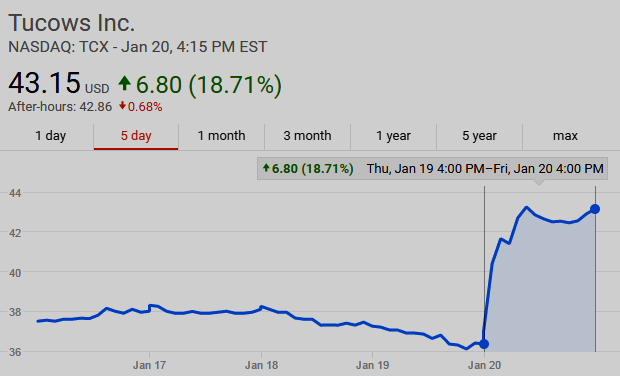
Domain Mondo's weekly review of internet domain news: Feature • Surprise announcements by buyer and seller early Friday, Presidential Inauguration Day in the U.S., new gTLDs registry operator Rightside Group, Ltd. (NASDAQ: NAME), sold its domain registrar business operating under the brand name eNom (eNom.com), to Tucows Inc. (domain: tucows.com) (NASDAQ: TCX) (TO.TC), and investors apparently liked the "win-win" deal:
Both $TCX and $NAME ended UP Friday, although Tucows had the larger gain:
"These two businesses have been competing for over 15 years. We know and respect each other. Each business also has particular strengths. Following completion of the transaction, we will continue to operate the acquired eNom properties under their current brands and we’ll maintain the existing reseller APIs, as well as the eNom accreditation, which means there will be no bulk migration of names required. We will also maintain the Seattle office."--Tucows CEO Elliot Noss, Conference Call Jan. 20, 2017. See also Tucows SEC filings.
Tucows' CEO Elliot Noss acknowledged eNom's growth prospects were neutral to negative but cited anticipated cost synergies over the next 24 months and the deal's additional cash generation as justification for the acquisition in a conference call and webcast Friday which is available for replay. UPDATE Jan 24, 2017: $TCX UP 35% since Jan 19th close:
Toronto-based Tucows is a provider of network access, domain names and other Internet services, including Ting (ting.com) mobile phone service and fixed internet access, OpenSRS (opensrs.com) domain registrar services (15 million domain names, a global reseller network of over 13,000 web hosts and ISPs), as well as Hover (hover.com), a domain name registrar. More information can be found on Tucows’ corporate website (http://tucows.com) and on Domain Mondo at Tucows Acquires eNom & Becomes World's 2nd Largest Domain Registrar. As a result of the deal, Domain Mondo has added Tucows Inc. (TC.TO) to its quarterly earnings coverage list. What's in the deal for Rightside? Besides the press release which cited the "divestiture" as enhancing "Rightside's ability to make additional investments in the Registry business as the market for new domains continues to develop," we may know more after the Rightside conference call and audio webcast with investors and analysts Monday, January 23, at 4:30 p.m. ET (1:30 p.m. PT): LIVE webcast
Live conference call: (844) 413-1777 (domestic) or (716) 247-5761 (international)
Conference call replay available through January 28, 2017: (855) 859-2056 (domestic) or (404) 537-3406 (international); Conference ID: 57050879; LIVE webcast and archived webcast at http://www.rightside.market.
Rightside's filing with the SEC in connection with the deal stated, in part:
"On January 20, 2017, Rightside Group, Ltd. (“Rightside” or the “Company”) and its wholly owned subsidiaries, Rightside Operating Co. (“Seller”) and eNom, Incorporated (“eNom”) entered into a Stock Purchase Agreement (the “Purchase Agreement”) with Tucows Inc. (“Tucows”) and Tucows (Emerald), LLC, a wholly-owned subsidiary of Tucows Inc. (the “Purchaser”), pursuant to which the Purchaser will purchase Rightside’s eNom business through the purchase of all of the outstanding stock of eNom from Seller in exchange for $83.5 million, less a net working capital adjustment of $6.8 million, resulting in net cash at closing of $76.7 million (the “Transaction”). The purchase price is subject to customary adjustments following the closing, including a working capital adjustment to the extent such amount is greater or less than the estimated net working capital amount determined at closing. At the closing, the Company will pay transaction expenses of approximately $4.0 million and substantially all of its existing indebtedness. The transaction is expected to close on January 20, 2017."
That SEC filing also disclosed (emphasis added):
" ... On January 20, 2017, the Company entered into a Limited Consent and Amendment No. 4 to Credit Agreement (the “Amendment”) by and among the Company, its domestic subsidiaries Rightside Operating Co. and eNom (together with the Company, the “U.S. Borrowers”), its foreign subsidiaries DMIH Limited, United TLD Holdco Ltd. and Rightside Domains Europe Limited (collectively the “Non-U.S. Borrowers” and together with the U.S. Borrowers, the “Borrowers”), Hot Media, Inc. and Acquire this Name, Inc., as guarantors, and Silicon Valley Bank (“SVB”), as lender and collateral agent. The Amendment revises the terms of the Company’s existing Credit Agreement, dated as of August 1, 2014, as amended (the “SVB Credit Facility”), by and among the Borrowers and SVB, which provided a $30.0 million revolving loan facility with a $15.0 million subfacility for the issuance of letters of credit. The Amendment, among other changes, releases eNom as a party to the SVB Credit Facilityand the assets sold in the Transaction from the collateral securing the obligations under the SVB Credit Facility; suspends the availability period for revolving loans, requires the Company to repay the outstanding revolving loans in full and reinstates the availability period once the Company satisfies certain conditions, including further amendments to the SVB Credit Facility and delivery of projections giving effect to the Transaction; lowers the total commitment from $30.0 million to $15.0 million; suspends the application of the financial covenants until the availability period for revolving loans is reinstated; and amends the financial covenants that will have effect once the availability period for the revolving loans is reinstated, including the maximum consolidated net leverage ratio, minimum liquidity ratio and minimum consolidated EBITDA. The Amendment further consents to the Transaction."
Friday's closing price on Rightside ($NAME) gave it a market capitalization of $178.9 million. Rightside stated Friday in its press release: "Following the transaction, Rightside will be in a strong financial position with approximately $90 million in cash on its balance sheet." Subtract the $90 million in cash, and the market is valuing Rightside's remaining businesses, principally Name.com registrar and Rightside registry (new gTLDs), at $88.9 million. In July, 2016, Rightside rejected an unsolicited offer from privately-held Donuts to buy Rightside's new gTLDs for $70 million in an all-cash deal.
Question: Is the market overvaluing or undervaluing Rightside's remaining businesses? See Rightside Q3 2016 financial results. It will be interesting to see the Q4 2016 and Q1 2017 financial results.
Other Internet Domain News:
• It doesn't matter how many new gTLDs ICANN creates because We're Going to Run Out of Company Names | Bloomberg.com: "There is a numeric limit to the universe of names, the combinations of letters of five syllables or less that are pronounceable, avoid offense in principal languages, and are not someone else’s property."
• Select ICANN officers and staff may have been busy partying this past week in Davos at the World Economic Forum as in past years when Fadi Chehade was ICANN President and CEO. The ICANN website offered little new "news" and, e.g., the Litigation Documents page has not been updated in weeks.
• Senator Ted Cruz (R-TX) has not forgotten about ICANN and the IANA transition, nor China, free speech, and tech, raising those issues at the confirmation hearing of Wilbur Ross, Trump's pick for Commerce Secretary, this week (2:50:33-2:52:52):
• John McAfee’s 3 major cybersecurity predictions for 2017 (via CSOOnline.com):
1. IoT denial of service attacks on major internet companies, like the one carried out on Dyn earlier year will become commonplace, and the severity will be orders of magnitude greater than what we have seen;
2. The anti-virus paradigm will finally been seen as a dead paradigm ... the world must move to proactive systems;
3. Intelligence agencies will finally accept the fact that a sophisticated nation state can perpetrate any hack and make it point to any nation or agency that they choose.
• 4 most popular posts (# of pageviews Sun-Sat) this past week on DomainMondo.com:
The S&P 500 closed up Wednesday (chart above) and has gained 6.18% since Trump's election on Nov. 8th.
Tom Barrack on Donald Trump's Inauguration and Cabinet Picks:
Video above published Jan 18, 2017: Colony Capital Founder and Executive Chairman Tom Barrack discusses the inauguration of President-Elect Donald Trump and the make-up of his cabinet.
JPMorgan CEO Jamie Dimon: Donald Trump's Reforms Could Cause Economic Growth
Video above published Jan 18, 2017: At the World Economic Forum in Davos, JPMorgan CEO Jamie Dimon talks about tax reform and President-elect Trump's economic policies.
NYSE Chief: Trump May Bring Better Times for Public Companies:
NYSE President Tom Farley discusses the markets under a Trump administration and his outlook for the future for public companies and IPOs. He speaks with Erik Schatzker from the World Economic Forum in Davos, Switzerland on "Bloomberg Markets" on January 17, 2017.
Wilbur Ross: I'm Not Anti-Trade, I'm Pro-Sensible Trade
Video above published Jan 18, 2017: Wilbur Ross, chairman and chief strategy officer at WL Ross testifies at his confirmation hearing for Secretary of Commerce. Full hearing video here.
Dow Chemical CEO: 4% Growth Is Possible Under Trump
Video above published Jan 17, 2017: Andrew Liveris, Dow Chemical CEO, explains what is needed to spark four percent growth in the U.S. economy and shares the details of talks with President-elect Donald Trump on stimulating manufacturing growth. He speaks with Bloomberg's Erik Schatzker from the World Economic Forum in Davos, Switzerland on "Bloomberg Daybreak: Americas."
Domain Mondo's weekly review of macro economic and investing news:
MacroViewFeature • Davos a/k/a World Economic Forum (WEF) Annual Meeting, will be held 17-20 January 2017, at Davos-Klosters, Switzerland, with Chinese President Xi Jinping speaking at the opening plenary and leading "an 80-strong delegation" of Chinese business executives and billionaires to the annual gathering of global elitists. Although WEF founder Klaus Schwab met with members of Trump’s staff in December, Trump spokeswoman Hope Hicks told Bloomberg.com that “No one will be attending.” Another senior member of Trump’s transition told Bloomberg that the gathering of billionaires and political leaders represents "the power structure that fueled the populist anger that helped Trump win the presidential election." See Davos Wonders If It’s Part of the Problem | Bloomberg.com:
"Kenneth Rogoff can pinpoint the moment he started to grow concerned Donald Trump would be the next U.S. president: It was when Rogoff’s fellow attendees at the World Economic Forum’s annual meeting last January said it could never happen. “A joke I’ve told 1,000 people in the months since leaving Davos is that the conventional wisdom of Davos is always wrong,” says the Harvard professor and former chief economist of the International Monetary Fund. “No matter how improbable, the event most likely to happen is the opposite of whatever the Davos consensus is.” The repeated failure of business and political elites to predict what’s coming—last year, that included the U.K.’s vote to leave the European Union—doesn’t strike those returning this month to the Swiss Alps as very funny. After a year in which political upsets roiled financial markets and killed off the careers of once-dominant Davos-going politicians, the concern for delegates attending this year’s meetingisn’t that their forecasts are often wrong, but that their worldview is." (emphasis added)
Davos is the Intellectual Yet Idiots IYIs annual convention, joined w/the International Association of Name Droppers https://t.co/XxfpBXTpSA
Chinese leader meets Davos elite as voters revolt | yahoo.com/news: "China's president [Xi Jinping] will preach the advent of a new world order in Davos next week before the high priests of globalisation, who are facing an uprising from voters against their orthodoxy of open markets and borders."
"[U.S.] dollars (USD) have a variety of utility value. They can used to buy other goods and services globally, serve as collateral for loans, earn interest with low transaction costs when converted into U.S. Treasury bonds, and so on. In certain ways, USD offer more utility value than gold or any tangible form of collateral/capital. If we refuse to recognize the high utility value of USD and its global ease of flow, then we will continue to misunderstand the demand for the dollar and its appreciation."--Charles Hugh Smith
Goldman Sachs alum and investor Raoul Pal: “Looking at the shortfall of dollars and what is happening in the world right now, I think it could probably rally something like 75% from its low, so that’s still a long way from here. My personal target for the last six years has been the euro goes to 75 cents against the dollar and the yen at 200.”-- Here’s why the U.S. dollar could soar by another 30% | MarketWatch.com. See also Bitcoin Collapses, Chinese Latecomers Get Fleeced | WolfStreet.com: "The People’s Bank of China announced on Wednesday that it is probing the major bitcoin exchanges in Beijing and Shanghai – BTCC, Huobi, and OKCoin – for a list of violations, including market manipulation, money laundering, and unauthorized financing. This is part of the PBOC’s efforts to crack down on capital flight ... The yuan lost 6.5% against the dollar last year, its worst year since 1994 ..." Other Macro Economic and Investing News:
• Billionaire investors and the Trump Rally: Carl Icahn, now appointed Trump's special adviser on regulation, says he left Trump's electoral victory party in the early hours of the morning of November 9th, to bet about $1 billion on U.S. equities. Icahn told a TV interviewer in early November that while the U.S. economy still faced a number of problems, Trump's victory represented "a major step in the right direction." WSJ.com reports billionaire investor (and Clinton supporter) George Soros lost nearly $1 billion in the weeks after the Trump election (Soros thought the stock market would decline), while Soros's ex-deputy, Stanley Druckenmiller, profited by betting on the post-election Trump rally in the stock market.
• Jim Chanos warns markets could be on verge of historic shift: For famed short-seller Jim Chanos, the big question for investors is to decide is "whether Trump's victory represents a major once-in-fifty-year sea-change in thinking about capitalism. If it is then you have to pay attention," he says. Chanos added, "if we look at the events of 2016 – Brexit, the Italian referendum, Trump, and the rise of nationalist China – are these the harbingers of something bigger? Or are they just a coincidence? The ground seems to be fertile for things to change globally." If so, this would have huge implications for investors: "If we're in one of those periods now – if 2016 is like 1932 or 1979 – then you not only have to change your portfolio, you have to change your lifestyle ... If this is a major shift to populism, nationalism, greater state involvement, and less globalism, then you really have to rethink almost everything in your life."
• Clinton Foundation shutting down the Clinton Global Initiative: Legal Notice filed with State of New York gives a "layoff date" of April 15, 2017, for the 22 affected employees. Whether the Clinton Foundation will also close is unknown. ZeroHedge.com reported donations to the foundation have collapsed "as the political cout of the 'charitable' organization dried up and as the opportunity for any future 'quid pro quo' is now effectively gone," while also noting that a FBI investigation into the Clinton Foundation regarding allegations of corruption is still ongoing.
• Inauguration of Donald J. Trump as the 45th President of the United States is set for Friday, January 20, 2017, see 58pic2017.org for more information.
U.S. Marines in the 2013 inauguration parade
One More Thing: Have You Heard the Latest Fake Newsfrom the Washington Post, New York Times, CNN, ABC, NBC, CBS, Wall Street Journal, Bloomberg, Sunday Times, The Guardian, BuzzFeed et al? Trump Aides Deny Sunday Times Report of Putin Iceland Summit | Bloomberg.com: "That is 100 percent false,” a Trump aide said late Sunday.
“If you don't read the newspaper, you're uninformed. If you read the newspaper, you're mis-informed.”--Mark Twain
Why Did BuzzFeed Publish the Trump Dossier? | The Atlantic.com: "In distributing a set of inflammatory allegations that it admitted it could not vouch for, BuzzFeed sidestepped [violated] a basic principle of journalism ... The reporter’s job is not to simply dump as much information as possible into the public domain, though that can at times be useful too, as some of WikiLeaks’ revelations have shown. It is to gather information, sift through it, and determine what is true and what is not. The point of a professional journalist corps is to have people whose job it is to do that work on behalf of society, and who can cultivate sources and expertise to help them adjudicate it. A pluralistic press corps is necessary to avoid monolithic thinking among reporters, but transparent transmission of misinformation is no more helpful or clarifying than no information at all."--David A. Graham, a staff writer at The Atlantic, where he covers U.S. politics and global news.
Read the tweet below carefully. This is journalism?
Confidential documents may contain damaging info. about Trump’s business & personal life. None of the details are confirmed to be true.
Martin Wolf on Davos economic outlook | FT Comment - Global growth, stock market volatility dominated discussion - Despite January being one of the most turbulent months on record for markets, delegates at the World Economic Forum are optimistic about the global economy. The FT's Martin Wolf explains why. Published Jan 24, 2016
Davos 2016 – all about tech | FT Comment - Technology companies had a huge presence at this year’s World Economic Forum. FT European technology correspondent Murad Ahmed explains how tech companies were greeted and how the industry was featured at debates in Davos. Published Jan 23, 2016
What did FT writers make of this year's meeting? 'Mastering the Fourth Industrial Revolution' was the theme of this year's World Economic Forum in Davos. As the meeting came to an end, FT writers provided their verdict on the key issues and highlights. Published Jan 24, 2016
The Transformation of Finance, Davos 2016 WEF Video: What trends and uncertainties are shaping the future of financial services? Transformations to be addressed:
Digitization and new business models
Regulatory requirements and new client needs
Data privacy and systemic connectedness
Speakers:
Dan Schulman - President and CEO of PayPal and Chairman of Symantec
Gillian R. Tett - author and journalist at the Financial Times
John Cryan - businessman and co-chief executive of Deutsche Bank AG in Frankfurt am Main
James P. Gorman - Chairman and Chief Executive Officer of Morgan Stanley
Tom de Swaan - Chairman, Interim Chief Executive Officer, Zurich Insurance Group AG
Christine Lagarde - Managing Director of the International Monetary Fund (IMF)
The parallels between the financial industry and the domain name industry are interesting--take note particularly (begins @37:00) the public role of banks and financial institutions as regulated utilities, with duties to act as extensions of law enforcement, required to collect and analyze data, report "suspicious" patterns and transactions, even closing customer accounts, etc.--if you want an insight into the future of the domain name industry and internet governance, watch this video.
Notes: What is the future of finance? What are the trends and uncertainties that are disrupting financial services, and how should we react? Panel member Christine Lagarde addressed this topic on the WEF website, Agenda. The Managing Director of the International Monetary Fund (IMF) looked ahead to what 2016 might hold for the global economy. She wrote:
“One reason that the global economy is so sluggish is that, seven years after the collapse of Lehman Brothers, financial stability is not yet assured. Financial-sector weaknesses linger in many countries – and financial risks are growing in emerging markets.”
“Putting all of this together, global growth in 2016 will be disappointing and uneven. The global economy’s medium-term growth prospects have weakened as well, because potential growth is being held back by low productivity, aging populations, and the legacies of the global financial crisis. High debt, low investment, and weak banks continue to burden some advanced economies, especially in Europe; and many emerging economies continue to face adjustments after their post-crisis credit and investment boom.
“This outlook is heavily affected by some major economic transitions that are creating global spillovers and spillbacks, particularly China’s transition to a new growth model and the normalization of US monetary policy. Both shifts are necessary and healthy. They are good for China, good for the US, and good for the world. The challenge is to manage them as efficiently and as smoothly as possible.”
“Our lives are being shaken to their very core by technological change, with the Fourth Industrial Revolution transforming economies as never before. The unprecedented speed of change, as well as the breadth and the depth of many radical changes unleashed by new digital, robotic and 3D technologies, is having major impacts on what we produce and do, how and where we do it and indeed how we earn a living. And while the transformation will proceed differently in advanced and developing parts of the world, no country or market will be spared from the tidal wave of change.”
It’s an interesting time for finance, says moderator Gillian R Tett. In 2007, bankers were on top of the world, holding their heads up high. Then, the crash, and since then many of the panels here in Davos have been dominated by what went wrong and what could be done to make things safer. Now, the discussions are forward looking, with less focus on regulation and more attention on fintech and the changes – both positive and negative – that are happening in the world of finance. The biggest challenge, argues Tett, isn’t a crisis in regulation, but the new players. Although regulation has moved out of the spotlight, there is still work to be done in this area, argues Christine Lagarde. There are issues between the US and Europe around over-the-counter derivatives and clearing systems which are not progressing at the speed at which they should. These areas need more regulation, says the IMF head. Basic retail banking is changing, Lagarde goes on to say. It’s being disrupted by innovations and there are people now who have never been – never had to – go into a bank. But this is merely another way of doing business. Virtual currencies and blockchains, on the other hand, can cause deeper disruptions. They may be relatively small (the current value of virtual currencies is around $7 billion), and may be nothing to worry about. They could also turn out to be beneficial – in reducing costs, providing better value and reaching the unbanked. But they could also a great instrument for crime. There is the potential for financing terrorism and the illicit economy, and they could disrupt monetary policy. The IMF has today released a report on this topic: Virtual Currencies and Beyond.
Will cash exist in the future?
The consensus is that, in 10 years, cash will no longer exist. Why? Because it’s inefficient, unnecessary and plays a key role in the illicit economy. Tom de Swaan believes that insurance will be the most affected of all the finance industries. Life at the top of a financial group was not, is not and will not be easy, because it is disruptive. “You have to find alliances with disruptors,” he says. “I haven’t met one who wants the insurance liability on their balance sheet.”
Dan Schulman, who heads perhaps one of the biggest disruptors in the industy – PayPal – says the biggest impediment to future success, is past success. “A lot of big companies extrapolate from what was and don’t imagine what could be. And this is a big danger.” His five key trends:
Money is definitely digitizing, cheques are disappearing. But let’s not forget that 85% of global transactions are still made with cash.
Mobile is exploding across the world. Soon everyone will have a smartphone and hold the power of a bank branch in one hand. This allows the industry to think about consumer transactions in an entirely different way, and it brings in billions of people.
The amount of data is exploding, and it’s not going to stop. Algorithms are the weapons of the digital company, and the ammunition is data. The better the quality of this data, the more value it is to the consumer. Security and privacy are genuine concerns, but data is going to change value propositions.
Industry lines are blurring, and product lines are blurring. Take digital payments – which involve tech companies, mobile carriers, handset manufacturers and merchants.
Security – something Schulman thinks about every day. There is so much data, and authentication is therefore very challenging.
Are regulators ready for this transformation?Tom de Swaan argues that regulators first need to define, what are they going to regulate? Privacy? The movement of data? The financial world is still rebuilding trust with consumers, and doing this while convincing them we need their data to create new products is a huge challenge. The regulatory environment also needs to be globally applicable.
Schulman: What are we trying to regulate, he asks? Let’s not look back at what happened, but what is likely to happen in the future. He thinks it’s likely a major hack could happen, but innovation needs to be responsible and we need to be able to try new things without worrying about over-regulation.
Lagarde supports Schulman’s idea of a “sandbox” to try new ideas, as this would help us to deal with trust and limit any damage to consumers. She doesn’t entirely agree, however, with John Cryan’s suggestion that regulation is made by policy-makers, rather than the regulators themselves. Governments do participate, she says, but the decisions are still being made by the likes of the Financial Stability Board and the Basel Committee, and then channelled into the regulatory system. For bad or for good, the profession still has a lot to do with how supervision is defined. Gorman believes that cyber-security issues need to be addressed. At the heart of the banking system, he says, is trust. When this goes, people want their money back, but the banks don’t have this money, they’ve given it to someone else, and this is what caused the 2008 crisis.
What about the future of blockchains? Cryan does not see this sector growing too quickly in the next 4-5 years. Banks are better prepared to manage cash flow of debt and are able to gain insights regarding the credit worthiness of debtors better than someone who can’t access this knowledge.
UPDATE Jan 21, 2016: Davos 2016 - Where Is the Chinese Economy Heading
With a new Five-Year Plan being presented in 2016, how can the world’s second-largest economy shift gears without stalling its growth engine? This session was developed in partnership with Bloomberg Television. Speakers: Jiang Jianqing, Francine Lacqua, Ray Dalio, Zhang Xin, Christine Lagarde, Fang Xinghai, Gary D. Cohn --Topics: Global Economy
World Economic Forum on Livestream.: "World Economic Forum The World Economic Forum is an independent international organization committed to improving the state of the world by engaging business, political, academic and other leaders of society to shape global, regional and industry agendas."
Facebook Inc. Chief Operating Officer Sheryl Sandberg, Google Inc. Chairman Eric Schmidt, Vodafone Group Plc Chief Executive Officer Vittorio Colao and Microsoft Corp. CEO Satya Nadella participate in a panel discussion entitled "The Future of the Digital Economy" at the World Economic Forum's annual meeting in Davos, Switzerland. Former SAP SE Co-CEO Jim Hagemann Snabe moderates. (Source: World Economic Forum)
Google Chairman Eric Schmidt: "The Internet Will Disappear" - The Hollywood Reporter: "... asked for his prediction on the future of the web. “I will answer very simply that the Internet will disappear,” Schmidt said. “There will be so many IP addresses…so many devices, sensors, things that you are wearing, things that you are interacting with that you won’t even sense it,” he explained. “It will be part of your presence all the time. Imagine you walk into a room, and the room is dynamic. And with your permission and all of that, you are interacting with the things going on in the room.” Concluded Schmidt: “A highly personalized, highly interactive and very, very interesting world emerges.”..." [starts @55:40 in video above]
Apparently Domain Mondo's post last week about ICANN CEO Fadi Chehade and his NETmundial Initiative project being among those "missing" at the World Economic Forum, appears to have been wrong as it is now reported that the ICANN CEO did in fact show up in Davos, at least long enough for a secret meeting with the rich and powerful that was not exactly successful--
Hibernating NetMundial rattles internet governance world at Davos • The Register: "... Even though the Davos launch was dumped, Chehade is attending the elite conference and has already ruffled feathers by continuing to promote NetMundial at a closed meeting of bigwigs... according to a Reuters reporter who was present. His remarks reportedly were not popular and sparked concerns of an elite group taking charge..."
After all, when an elite gathering of the rich and powerful are alarmed that your idea sounds like an elite group taking charge of the internet, maybe it's time to stop and listen, and consider dropping the whole charade. But if the track record of ICANN ignoring sound and wise advice in its new gTLDs program is any guide, Fadi Chehade will continue to make a pest of himself at Davos, until Klaus Schwab says "enough!"


 Amazon's AWS is the "internet’s largest cloud provider, generating over $17 billion in revenue last year. Though Amazon makes much more in gross sales—over $100 billion—from its retail business, if you scrutinize its earnings reports, you’ll see that the majority of its profits come from AWS. Tech is where the money is, baby."--gizmodo.com